A dear friend died last week at age 96. I’d been visiting her for eleven years. Her health had been declining and she recently went on hospice care, so it was not a surprise. But it’s hard to accept.
In my visits with her, we explored a wide range of topics: timeless spiritual questions, great works of art, music (Bach, Mozart, old hymns, and popular songs), politics, and her rich personal history, among others. We’d often jump from one topic to another and lose track of time. We were frequently surprised at how quickly the time passed and exhilarated by all the ground we’d cover.
I know she is “gone.” I simply can’t believe I’ll never have a chance to visit her again. I can’t believe a light that burned so brightly in my life has disappeared from my sight.
I play hide-and-seek with our two-year-old granddaughter. One of us disappears around a corner in the house, and the other comes searching. When the seeker finds the hider, we share an exclamation of delight. I want to go looking for my departed friend, but I know I will not be able to find her. Where did she go?
And every time we go out in public, how many people do we pass by who are having similar thoughts as they go thorugh their day?
When will it be time for me to disappear? Will I see it coming?
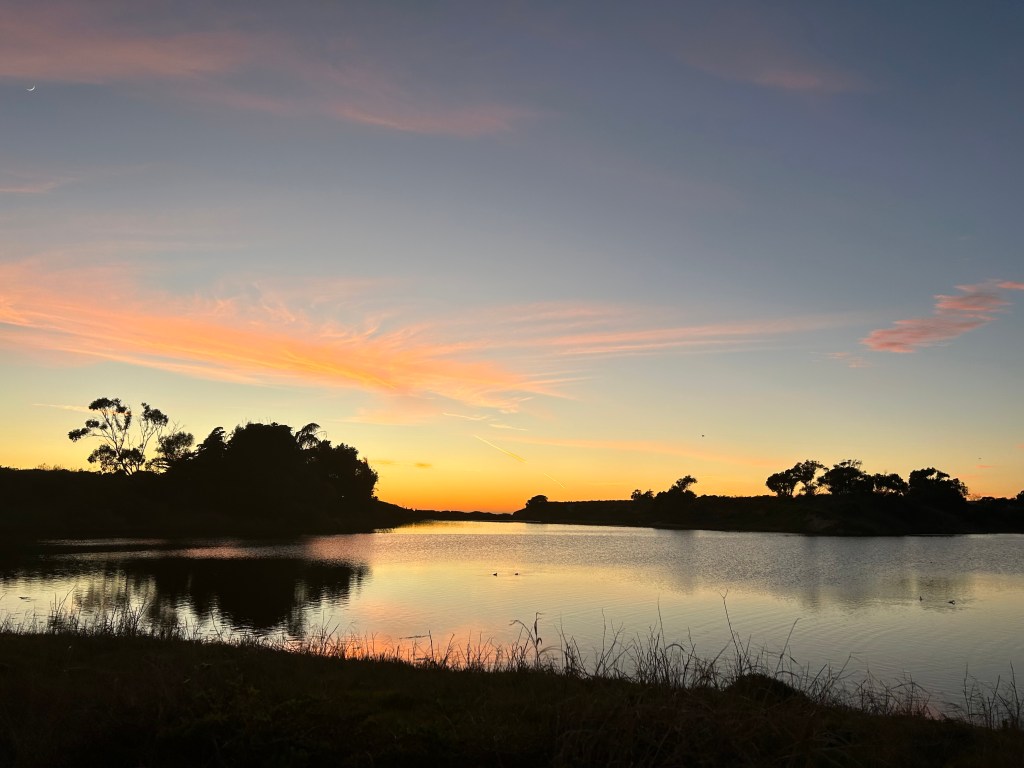
(Top photo: Night sky over our house; lower photo: UCSB Lagoon at sunset)
In the eighties, a seminary friend underwent a kind of conversion. He’d been raised with an older form of theology which held that this life is full of sin and suffering, and our best response is to focus on the hope of heaven. But he became convinced that this perspective was misguided. It had led our culture into an attitude of disregarding the integrity and sanctity of creation, which in turn contributed to the degradation of the environment; it also kept us from appreciating the blessings present in everyday life. He began to see divine life embedded in the natural world and became an early supporter of the “eco-spirituality” movement. “Faith isn’t just about the pie in the sky,” he’d say, “the sky is in the pie.” In other words, the divine presence surrounds us, and a primary spiritual calling in our time is to protect and nurture the earth and appreciate all that it offers.
A turning point for me was reading Original Blessing, by the feisty priest and scholar, Matthew Fox. Fox pointed out that Western theology had mistakenly become fixated on the doctrine of “original sin” in the fourth century and has never let it go. But the Hebrew Scriptures – and Jesus’ teaching — are pervaded with the theme of life being a miraculous gift, not a curse.
I appreciate the times in human history when peoples’ lives were full of suffering and focusing on future life in heaven – “pie in the sky” – made sense. There are many great spirituals with that theme, and no doubt they were powerful medicine. I honor and appreciate that experience. But if that is the sole focus of our spiritual life, we are missing so much.
I confess I come to this theme with a formidable bias – since the time I was a kid, I’ve loved pies. It started with Mom’s apple pie. Then it expanded to lemon meringue pies at Denny’s. It grew further with a masterpiece made with home-grown pie cherries from the baker’s tree in her backyard. These all tasted “heavenly” to me; literal affirmations that “the sky” can be experienced “in the pie.”
I remember the first time I stayed at a monastery — St. Andrew’s Priory near Pearblossom. I was expecting to be served some kind of thin gruel. But when I came into the dining room, a great, multicourse feast was laid out. It turned out they were welcoming a new novice to their community, so it was my good fortune to be there as they celebrated with this banquet. I later learned that the monk who cooked that night had been a chef with the Hyatt Regency before taking his vows.
Several years later I was spending a day at Mt. Calvary Monastery here in Santa Barbara. Before lunch was served, the host said, “We don’t know if God has taste buds, so we consider it a spiritual duty to enjoy what we eat.”
I’m hoping I can have it both ways. If there is “pie in the sky” after this life is over, I’m all for it. But I’m not missing any opportunities on this side of the great mystery. I’m hoping to have my pie and eat it too.
Merriam-Webster’s Word of the Year for 2023 is authentic — the term for something we’re thinking about, writing about, aspiring to, and judging more than ever.
A high-volume lookup most years, authentic saw a substantial increase in 2023, driven by stories and conversations about AI, celebrity culture, identity, and social media.
Authentic has a number of meanings including “not false or imitation,” a synonym of real and actual; and also “true to one’s own personality, spirit, or character.” Although clearly a desirable quality, authentic is hard to define and subject to debate—two reasons it sends many people to the dictionary.[i]
When I think of the word authentic,” I think first of food: “That place serves authentic Mexican food” someone will say; “If you want to know what an authentic bagel tastes like, you’ve got to go to New York.”
Occasionally we have pizza delivered from one of the popular places in town. But recently we got some from Ca’Dario’s, a wonderful Italian restaurant in town. The crust was quite thin, as it is in Italy. My 8-year-old grandson picked up a piece and said, “This isn’t real pizza.” I asked why. He said, “It has a floppy crust.” Authenticity can be in the eye of the beholder.
I think of art. Occasionally we will read of some expert declaring that someone paid a lot of money for a work is fake.
We can debate what makes food or art authentic, but how about people? It’s hard to say how we know someone is “authentic.” Maybe we could start with what must be the opposite trait — “phony.”
Sometimes we encounter people who say and do all the right things, but after we are around them, we get the feeling they aren’t authentic. We say things like “They’re just putting on an act.” We can resonate with that 1971 soul classic, “Smiling Faces:”
Smiling faces, Smiling Faces, Sometimes they don’t tell the truth.
Smiling faces, Smiling faces tell lies and I got proof.
Beware. Beware of the handshake that hides the snake,
I’m tellin’ you beware of the pat on the back it just might hold you back.
So, we might sense when someone is not authentic, but how do we know if they are?
Since the sixties, we have often heard that we each need to find our true ‘authentic” selves. That can mean uncovering some gifts, talents, or creativity we didn’t know we had – a wonderful thing. But I think it can also become a guise for being selfish – we decide we will act however we please and expect the world and other people to adapt to our needs. Spirituality in that realm can be finding a set of beliefs that fit perfectly with what my ego wants.
From the point of view of the established spiritual traditions, the best way to find our “authentic self” is to experience and serve a purpose and presence greater than ourselves. “Whosoever shall seek to save his life shall lose it, and whosoever shall lose his life shall preserve it.” (Luke 17:33) This is an invitation to imagine there is a way of being beyond my little self and to discover the wonder of being part of it.
I think of the Prodigal Son story. The younger brother takes half of his inheritance, leaves home, and spends it all on himself. The money runs out and he finds himself in a moment of despair which leads to a discovery – “he came to himself.” He returns to rejoin his family where he finds love and belonging.
I had a parishioner who is very quiet and prefers to be in the background in any situation. She is always thinking of others, visiting them when they are sick or sad or alone. She’s now 102 years old. If you asked her if she’d found her “authentic self,” she would be mystified by the question. Her “real self” doesn’t exist in isolation as a trophy to display; it lies deeply in her connection with other people. Her authenticity is a product of her humility.
I went on quite a few trips with teenagers to build homes in Mexico. In the beginning, many kids were concerned they wouldn’t have the daily conveniences they were used to. But when the work started, they forgot about their devices. At evening campfires, as they reflected on their lives, it seemed to me they were finding their “authentic selves” by experiencing a bigger world – one that is challenging and engaging, but also includes a core element of serving others.
As the announcement noted, one reason there has been so much interest in what is authentic is the advance of Artificial Intelligence. This week I was making a hospital visit and saw a woman I know. She told me of a sermon her assistant rabbi had recently given on the topic of AI. She said it was an impressive presentation, but along the way, she and others felt somehow, something was off. At the end, he told everyone the sermon had been entirely written by an AI Chatbot – then offered some thoughts about what that means. “You just knew something wasn’t right,” she said, “But you couldn’t put a finger on it.”
AI is rapidly becoming more and more capable of creating materials and relationships that will seem more and more “authentic.” What will life be like?
Although clearly a desirable quality, authentic is hard to define and subject to debate—two reasons it sends many people to the dictionary. Pondering the word sends me not only to the dictionary but more and more into a new appreciation of being with real, down-to-earth people in my life who aren’t trying to be authentic — but are. What a blessing.
On December 15, 2020, I posted my first “PocketEpiphanies” article. My goal was to share some of the insights, memories, and stories that have been meaningful to me over my life and career that might also be of interest to others.
I did not know how long I would keep at it.
As of last week, I’ve written 150 articles now have 169 subscribers. I’m surprised I’ve gotten this far.
From time to time, I’ll receive a message from someone that a particular post was helpful to them in their journey. When I’m out and about in town, I’ll meet one of you and you’ll tell me you look forward to seeing what I come up with each week. This makes it worth it.
I have decided that reaching the 150-post milestone is a good time for a break. Over the next few weeks, I’m going to let my mind and imagination lie fallow. I plan to resume on January 6. Until then, please know that being connected with all of you means a great deal to me. In these fractured times, I feel this is one way to stay in touch with one another about what matters in life without trying to “monetize,” advertise, or become an “influencer.” Thank you for being part of this journey.
Steve
P.S.: If you haven’t been with me since the beginning, you may want to see what I posted two years ago– pieces written to reflect themes of the season.
I am fond of each of these three statements and think they are saying the same thing in different ways:
“We walk by faith and by sight.” – world religion scholar Huston Smith.
“Pray for a good harvest and hoe like hell.” – a saying I heard once from a farmer.
“The compass points you true north but does not warn you of obstacles and swamps along the way.” – Abraham Lincoln in Steven Spielberg’s film, Lincoln.
I found the Huston Smith statement as I was reviewing my notes from my time with him at Esalen in 2010. I don’t have a record of what led him to quote this or what comments he made about it. But I believe it’s worth exploring.
If you have been nurtured in the Christian tradition, it may sound as if he was misquoting a famous passage from St. Paul: “We walk by faith and not by sight.” (2 Cor 5:7). Over the years, I have heard this read and sung to remind the faithful to trust in divine guidance and providence even when we can’t see how things are going to work out. We can become over-reliant on “sight” — our current understanding of whatever situation we are facing. This can lead to despair if we don’t “see” a way through a situation. But reminding us to not be limited by what we see, and instead trust that God is at work in our lives can ease our anxiety and give us courage.
But Huston must have liked turning the phrase into “We walk by faith AND by sight.”
As a scholar of global spirituality, he knew every tradition assumes a certain amount of faith and trust in a greater reality beyond our everyday knowing. Throughout his life, he was plumbing the depths of mystical experience and spiritual ways of understanding life. But he was always in dialogue with scientists, psychologists, and philosophers as they described what they see as real. Rather than make it either/or, he encouraged people to use both faith and reason to navigate life’s challenges.
The quote about farming can at first sound a bit cynical. For some devout folks, praying for a desired outcome should be enough…isn’t it a bit disrespectful to imply one needs to “hoe like hell?” Praying for a desired outcome can open us to forces beyond our sight that can bring unexpected blessings. But we can’t just pray and sit back. We’ve got to do our part – put in all the necessary hard work as we go along.
In the Lincoln movie, the President is in a conversation with Senator Thaddeus Stevens, an abolitionist who is focused on establishing complete equality for African Americans. While Lincoln agrees with him in principle, he knows it’s not possible in the politics of their historical moment. Complete equality is the “true north” they both seek, but there are many swamps along the way; better to get as far as you can towards the goal than be so high-minded that nothing changes. Stevens eventually conceded and Congress passed the 13th Amendment.
I believe in the power of faith and believe we must keep our eyes open as we make our way through life. I believe in praying for good outcomes and know we need to be ready to work hard to realize them. I think we must know where true north is in our lives and accept the fact that there may be many swamps that must be negotiated as we head that direction.
I think of this when I see people face serious medical issues. Some people of good faith want to trust that faith or positive thinking alone will lead to healing, with little need for medical knowledge. But the wiser people I’ve known blend both. They find the best doctors and learn all they can. They also know there are “unseen” forces that can contribute to healing, like meditation, prayer, social support, and guided imagery. They walk by faith and by sight.
I think about this with marriage and family. Over the years as I’ve met with couples as they prepare for making the commitment. I affirm the power of the love, hope, and faith that is leading them. I also encourage them to remember that much work will be required to honor their highest hopes.
And I think of this with the many great nonprofits I’ve been associated with over the years – Isla Vista Youth Projects, Hospice of Santa Barbara, La Casa de Maria Retreat Center, and the Neighborhood Clinics. They all start with an inspiring vision and faith in what they can accomplish. But to survive and thrive requires endless hard work, strategic decision-making, and survival skills. Faith and sight need each other.
A colleague once told of visiting an older writer in Paris whom she’d always admired. The woman welcomed her at the door and invited her in. The apartment was full of books, papers, and artwork and it was not clear where to sit. The woman gestured toward a chair that had some books and papers on it. “Oh, just put those anywhere.” My friend picked the items up and was about to place them on a small empty table nearby, but the woman said, “Oh, not there. I try to keep one space empty and open wherever I live.” And she indicated a different spot to lay the items.
My friend said she never forgot this idea: that even in the smallest of residences, it may be a worthwhile practice to have one place that is not covered with things, but always “empty and open.”
This time of year, it’s common to bring out all kinds of things that speak to us of the meaning and memories of the season – figurines, candles, ornaments, greens, lights, seasonal books, etc. I have several playlists of music I return to every year, which fills the air with music. It can be a busy and joyful time.
I’ve been thinking — What would it be like this year to create an “empty and open space’ in our living space? What if we choose a spot that we see throughout the day that will remind us to be inwardly open to silent truths, fresh inspirations, and the savoring of mystery?
In the Biblical story of the angel coming to Mary, she is essentially asked if she will be open to a new life coming into this world through her. She says yes, and the life arrives from a realm beyond her knowing.
Isn’t it the same with all children? We understand how the biology works, but the way children seem to each arrive with a unique soul and presence is surely a wonder. David Brooks tells of a friend whose spiritual journey began as she held her first child in her arms and thought, “I love this child more than evolution can explain.”
In the Mexican tradition of La Posada, Joseph and Mary travel from house to house, asking if they might stay for the night. Time after time they are told there is no room for them. In the end, the only ‘open space” they are offered is a manger. But it is enough.
I’m going to try this out. My desk sits next to a bookcase where every shelf is often full of books and CDs. But I decided to clear off one eye-level shelf and leave it bare for the month. When I’m tempted to place something there, I’m going to tell myself, “Oh, not there. I try to keep one empty and open space wherever I live.”
“How silently, how silently, the wondrous gift is given…” In silence and emptiness and openness gifts can appear that may surprise us.
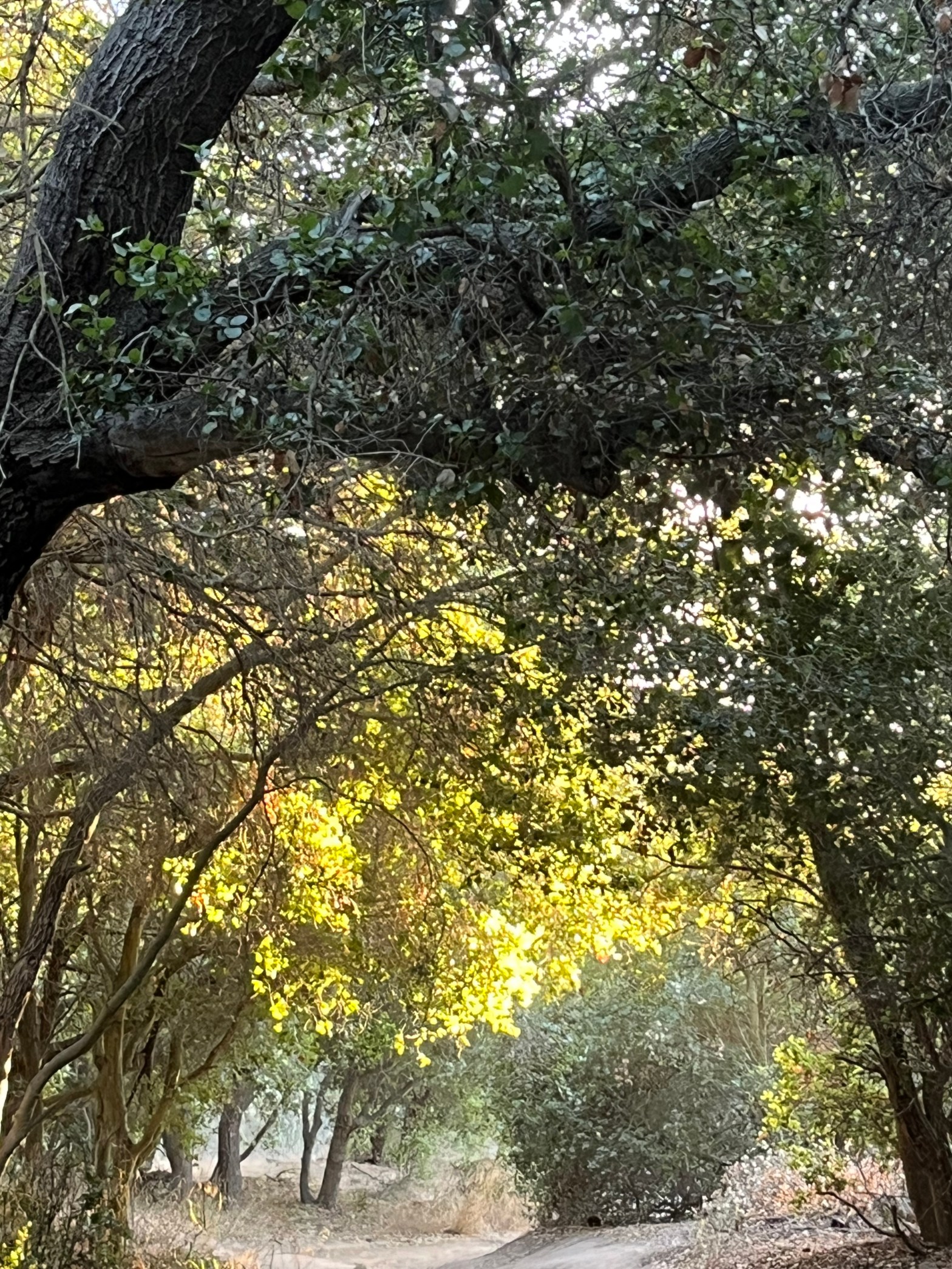
One recent afternoon my wife and I hiked up a local canyon. On our way back, the sun was beginning to set, and shafts of life were cutting through the oak trees. We stopped to take a few pictures. Here’s one:
As we resumed walking, I began thinking about how our awareness is naturally attracted to whatever in our environment is illuminated. For example, in this photo, I find myself looking at the lower half where the light is brightest.
This can be a kind of bias — to the tree itself, the parts that I don’t notice because they are in the shadows are just as important as the parts reflecting the sunlight. I was reminded of a timeless Sufi tale about a man looking for a lost key:
The great Sufi master Mullah Nasruddin was on his hands and knees searching for something under a streetlamp. A man saw him and asked, “What are you looking for?” “My house key,” Nasruddin replied. “I lost it.” The man joined him in looking for the key, and after a period of fruitless searching, the man asked, “Are you sure you lost it around here?” Nasruddin replied, “Oh, I didn’t lose it around here. I lost it over there, by my house.” “Then why,” the man asked, “are you looking for it over here?” “Because,” Nasruddin said, “The light is so much better over here.”
This tendency has since become known as the “streetlight effect: “a type of observational bias that occurs when people only search for something where it is easiest to look.”[i]
A psychology professor once described how our unconscious mind is often working to solve problems without our awareness, and sometimes we need to give it some space to help us. He gave the example of trying to remember someone’s name. We may stop and try harder and harder to concentrate on locating the fact — like turning up the power on our flashlight to maximum power – but that doesn’t seem to help. He suggested we try letting our focused search go for a minute and shift our attention to something else, like looking out a window. When we do that, the name we are looking for will often appear in our awareness like a gift out of the blue. Turning our attention elsewhere allows the answer to come to us from “the shadows” of our mind.
I’ve applied this often in conversations. Someone is telling me a story and gets stuck trying to remember a name. They get frustrated when they can’t come up with it. I’ve learned to say, “Just keep telling your story and it will come back to you.” Almost always, when they resume their story, the fact will come to them and they’ll say, “Oh, now I remember…”
During COVID, I took some Zoom writing classes from Marilyn McEntyre. One of them was called, “Writing Into The Unknown.” Marilyn told of being in graduate school and meeting with a professor to receive a paper he had graded. He told her it was flawlessly done. “But,” he said, “it’s boring.” He encouraged her to take more chances. She realized she had always depended on using outlines, knowing exactly where she was going when she started to write. This can be useful in some situations. But it can be an impediment in creative and personal writing. She encouraged us to start with a hunch or a feeling and see where it goes. Often, we surprise ourselves by discovering insights we didn’t know were “in” us. Moving away from the lamppost can lead us to the key.
This resonates with the book In Praise of Walking,[ii]which I wrote about some months ago. If we have been working on a problem at our desk and feeling stuck, it’s well worth our time to get up and go for a walk. As our attention shifts away from the problem, interesting ideas often bubble up to the surface of our awareness. What we’ve done is give the unconscious/shadow part of our mind a chance to share what it’s quietly been working on all along, and it rarely disappoints.
In recent years, I’ve become more aware of “somatic intelligence” – the capacity of our body to know things that our conscious mind hasn’t figured out yet. Sometimes we “get a feeling” about someone or something and we’re not sure where that comes from, but the feeling/thought turns out to be valid. We use our rational mind to evaluate what we are feeling, but we do so while recognizing we may know more than we can say and be open to the unseen within us.
Let’s go back to the photo of the tree. At first, all my attention was drawn to the lower half. Here’s what the upper section shows:
A very different look from the lower half. And the more I look at it, the more mysterious and interesting it becomes – so dense with intertwined growth representing years of making its way in this canyon.
Here’s the original photo, with the illuminated parts of the tree integrated with the shadow side. Together, they form a whole:
May we appreciate the different aspects of our personal awareness as we navigate the wonders of this life.
This past Monday, I had surgery to repair a torn rotator cuff in my right shoulder. As a result, my right arm is in a sling for the time being. This is a common procedure that many of you have gone through, and minor compared to the challenges so many people face. But, for the first time in my life, I am going through routine daily tasks without the use of my right arm to do things like sign a check, pick up a box, guide the computer mouse, or drive to the store. I am finding an increased awareness of the things that I “take for granted.” And my curiosity has lingered on the word: “granted.“
The word “grant” can mean: “to give or allow something, usually in an official way.” We may receive something we desire, but it’s not something we have control over – like being granted a pardon or receiving a grant to fund a project.[i]
The meaning expands when we “take something for granted:”
Here is one definition: “To believe something to be the truth, without even thinking about it; for example, “I guess we all took it for granted that water would always be freely available.”[ii]
I think of my right arm: How many millions of years of evolution did it take to create and engineer this arm? How many of my biological ancestors helped develop its capacities, passing on what is advantageous to future generations and ultimately to me? My right arm and its capabilities have all come in the form of a grant. I have never thought of it that way – I have always taken it for granted.
In 2010, we made a 12-hour journey to attend a week-long yoga retreat near Mount Shasta. That night, I got up out of bed and discovered my left side was partially paralyzed and my speech was impaired. I was taken to the local hospital where I spent the night, not knowing whether the damage would be permanent or temporary. As it turned out, it was a passing incident; my capacities returned by noon the next day and I was discharged. Two days later I went to the morning yoga class to see if I could manage some simple stretches. In one posture I was bending over my outstretched left leg when I suddenly realized that this left leg, which had not been functioning just two nights before, was now responding to my intention as if nothing had happened. For the first time in my life, I looked at my left leg with awe and appreciation; I began silently singing to myself an old Van Morrison song, “Have I told you lately that I love you?”
This could have been the first time someone had sung that love song to their leg. All my life, I had taken that leg “for granted.” But for a while I lost it, and then it came back. I did not want to take it for granted again.
The tangible experience of taking something for granted, having it taken away, and then having it restored, fills us with gratitude.
Of course, many things that get taken away from us are never going to be replaced, including people we love. I remember a colleague telling me of his conversation with a person who was highly esteemed for both his spiritual depth and his leadership. The gentleman was a widower in his early 80s at the time. My friend asked, “What’s it like to have made it so far?”
“Nobody prepared me for the amount of loss that comes,” he said.
Regularly reminding ourselves of all the blessings in our life helps ground us; it keeps us from rushing through our life day after day until suddenly we realize we’ve lost so much without ever appreciating it. But I can’t imagine trying to list all the gifts and blessings I “take for granted” – there are just too many. Moment by moment, day after day, we move through life sustained and empowered by them without realizing it, the way a dolphin thrives as it swims through the sea. I may not recognize how much they mean to me until I lose them. But I am thankful for all I’ve been granted nevertheless.
Two dogs are looking at the stars at night. What might they be thinking?
I have no idea.
But in a recent New Yorker contest, three people came up with these possibilities:
Aren’t those great? Each is a delight…and a very different and original response to the same drawing.
How about this one?
Try taking just a minute before looking at the three responses….
…and here they are…
My first thought: Isn’t it amazing what four people can do — the one who had the idea of the drawing and sketched it, and then the three people who each came up with a delightful range of ideas?
My second thought: How often have we been taught – or assumed – that there is only one “right answer” to a question?
Of course, everyday math problems have one right answer. You give a barista a $5 bill for a $3.25 cup of coffee, and you expect the change to be $1.75.
But there are situations where there can be more than one “right” answer.
I was in an organization development class where we were introduced to “equifinality.” Here’s one definition: Equifinality is the principle that in open systems a given end state can be reached by many potential means.[i]The presenter said that it’s common to be on our own or in a group working on a problem, and when the first possible solution appears, we accept it and move on – assuming it is The Answer. But remembering that there may be more than one solution can open us to more creativity. He encouraged us to always look for at least three possibilities, and then decide which one is best.
I think of this when people are looking for a life partner. The phrase used to be, “I’m looking for Mr. Right.” But there may be several potential mates that would work out well; one’s life may turn out differently depending on each person’s characteristics – each rewarding in different ways.
This can be useful in hiring. We can create a job description and have a clear idea of what “the ideal candidate” may offer. But there could be several good candidates who would become excellent employees, each bringing a different set of gifts.
This is true in the arts. A great painting can mean different things to different people. A song like “Amazing Grace” can be sung in many different styles and sound inspired each time.
And this is exactly why I love dealing with the great stories of our spiritual traditions year after year. Each time I turn to them, I work and walk and wonder as I seek an insight that feels fresh and relevant until I find one. Five years later, I’ll come back to the same text and find something new. That doesn’t mean the prior idea was “wrong;” it means great stories, poems, plays, and works of art have inexhaustible possibilities. They’re not dead things. They are portals into our imagination and experience.
The French philosopher Paul Ricouer said that timeless stories, legal principles, and works of art can have a “surplus of meaning.”
I am reminded of this principle as we witness social and political conflicts. There’s got to be more than one way to work things out.
Let’s end with this image of two ears of corn discussing what it’s like to be popped:
Note: The cartoon with the dogs is from the September 25 issue and the ice cream cone cartoon is from the October 16 issue. When I cut out the cartoon with the popping corn, I failed to note in which issue it appeared. This is a case where there is One Right Answer, and I don’t have it.
AnotherNote: All honor goes to the New Yorker, where the genius of cartoon artists is reliably on display week after week after week.
I remember Huston Smith describing his first meeting with the Dalai Lama in Tibet. In 1964 the Dalai Lama was in his twenties and not well-known. Huston was a young scholar in India studying Buddhism and had been told he should meet this new spiritual leader. After they greeted each other and he agreed to be interviewed, the Dalai Lama turned to escort Huston to the next room; Huston overheard the Dalai Lama say softly to himself, “This may be important. I need to be attentive.”
Fifty-six years later, I was spending five days with Huston Smith and two dozen others at the Esalen Retreat Center in Big Sur. I’d followed his writings for many years and heard him speak in Santa Barbara several times. He’d grown up in China where his parents were Methodist missionaries; the essence of what they taught him was “Be thankful for what you have and bear one another’s burdens.” He grew up speaking English and Mandarin and delighted in Chinese folk culture. He came to the U.S. for college and then spent his life traveling the world learning all he could about the great spiritual traditions. He summarized what he’d learned by writing The World’s Religions, which has sold over 3 million copies.
Huston was not only a learned man but also a humble pilgrim; he wasn’t just smart, he was wise. When he spoke, his face would often break into a wide smile and a bright light shined from his eyes. The chance to be with him for five days of conversation was a dream come true. My notebook is filled with things he said I wanted to remember. This week one phrase came to me: “Mind Proposes, Soul Disposes.”
I take this to describe an experience we all are familiar with. A thought arises within our mental awareness that seems like a suggestion or an impression. It can appear like words on our inner screen or maybe our personal voice speaking to us from within. This is the “mind proposing.” What do we do with this “proposal?” A different kind of awareness comes into play as we consider the suggestion. We ask ourselves: “Is this the way I want to feel?” “Is this suggestion something I really want to do?” “Is this a path I want to follow?” As we decide, it is the “Soul Disposing” – our inner, “Higher self” coming into play, indicating a possible direction like a compass. Then it’s up to us to decide if we go that way or not.
Much of our daily life can be spent without the “soul disposing.” An idea occurs to us, and we act on it without much thought: “Time to get up.” “I’m going to make some coffee.” “I’m going to get the mail.” Such actions don’t require a great deal of careful reflection. But sometimes there are important crossroads we come to when our mind is proposing an action or direction, and we recognize we need to “think about it.” To put it another way, we need our “soul” to help us – we want to make a good choice, the “right” choice. Our soul draws on our deepest values and aspirations. I think this is what the Dalai Lama was reminding himself to do before he sat down for the interview: “I need to be attentive.”
The psychologist and holocaust survivor Victor Frankl famously said it this way: “Between stimulus and response there is a space. In that space is our power to choose our response. In our response lies our growth and our freedom.”
For some of us, this is where spirituality comes into play.
I’ve been reflecting on what “spirituality” means for a long time. One way to define it is a personal sense that there is something greater than us in this world. On the one hand, this humbles us. On the other hand, this inspires us. The great traditions tell us stories that can amaze us with their insight. They teach us to see our life as a divine gift and to embrace the call to serve others. They give us practices to develop and stay in touch with our “souls” – through worship, prayer, music, study, community, time in nature, and acts of service. When we reach moments when our “mind” has “proposed” an important action, we can call on what we’ve learned to “dispose” of the options, helping us recognize which one we want to pursue.
Three weeks ago, a friend called to tell me a wise mentor and treasured friend to both of us had suffered a stroke and was in the ICU. He was 92. When I visited the next day, we had a brief but meaningful conversation. I had recently written him a letter, telling him how much he had meant to me at different times in my career; now I was grateful I had not waited to do that. He knew how much he meant to me.
I asked him if he’d like me to pray with him, and he said yes. Over the years, I’ve learned to ask people what they want me to pray for, rather than assume I know. I asked. He said, “Acceptance.” We prayed for that. I visited him two days later and he died the next day.
Looking back, I realize he always listened to others carefully. And when he spoke, you sensed it was his soul calmly speaking to you, often with a smile.
“Mind Proposes, Soul disposes.”
“This may be important. I need to be attentive.”
“Between stimulus and response there is a space. In that space is our power to choose our response. In our response lies our growth and our freedom.
Our Soul often wants to speak. It’s up to us to take the time to listen.
Huston Smith and me, Esalen, 2010; he was 91 at time.