Starstruck: The Relationship Between Awe and Caring

When we get away from city lights and look up to behold the fullness of the night sky, it’s hard not to feel a sense of awe.  Awe reminds us how “small” we really are, yet, paradoxically, it’s exhilarating.  We feel better having been reminded that there is such an amazing world beyond us.  But I did not know there is a connection between experiences of awe and how we act towards other people.

In a recent column, Cal Berkeley psychology professor Alison Gopnik cites several studies that explore this connection[i]:

One study found this: “When people gaze up at an awesome sight like an eclipse… they become more humble and caring when they look down at their Twitter feed.”

Here’s another: “…people were shown videos of earthbound awe-inspiring sights like a towering tree, a sublime landscape or an erupting volcano. Afterwards they felt less significant themselves and more caring toward others.”

And she cites another that includes spilled pens: “… researchers placed students in front of either the majestic Berkeley Eucalyptus Grove or a tall but boring campus building. A confederate then came by and dropped a bunch of pens on the ground, apparently by accident. The awe-struck students in the grove put more effort into helpfully collecting the dropped pens than did the students by the mundane building.”

Here’s more: “But what about in real life outside the lab and university? In the new study, the researchers cleverly took advantage of a natural experiment—the total solar eclipse of 2017 and the millions of people who tweeted about it. First, they analyzed over eight million tweets and compared people who were in the path of the total eclipse to those who were not. Unsurprisingly, people who experienced the eclipse expressed more awe than those who didn’t, using more words like “amazing” and “transcendent.

But they also used more words expressing social connection, like “care” “love” and “thanks,” and they expressed more humility and tentativeness, saying “maybe” or “perhaps.” They even said “I” less and “we” more than people outside the path. A further analysis showed that how social and humble people were depended on how much awe they expressed.

Isn’t that fascinating? Yet, somehow, it makes sense. 

I regret I have not spent more time at high elevations where the sky is at its most dazzling.  I remember being on a hike a few years ago in the Sierras, and before going into the tent late at night, looking up and being overwhelmed by the sight of the sky.  I long to go back to that spot and simply lie on my back, being absorbed by wonder.  It “humanizes” us – or, perhaps, “spiritualizes us. Or perhaps they are the same thing.

On the terrestrial plane I have felt something surprisingly similar during worship services.  I’ve led and attended many in my life, and some are certainly forgettable.  But some are transformative.  It happens often at a simple memorial service: you hear about some small act of kindnesses the person did, or how a challenge they faced gave someone courage to face their own hardships, or you hear their favorite song sung with care and love.  What’s remembered are moments when the person’s soul seemed to quietly connect with another.  It reminds me of how extraordinary life is. And as I mingle with others at the reception, we’ve been reminded of mortality as well as what endures, and it’s as if I’m seeing each person with more clarity and reverence than I did before the service.

Gopnik comments: These results might help to explain a rather puzzling fact about spiritual experiences in general, whether they are the result of organized religious practice, secular meditation or even psychedelic rituals. On the one hand, these experiences often involve a very personal and private experience of awe, a sense of transcendence. But at the same time, they seem to lead to very real and down-to-earth actions to help other people.

And she concludes: “The mystic’s ecstasy might seem far removed from the homeless shelter or soup kitchen, and marveling at a grove, cathedral or eclipse might seem to have little to do with saying ‘we’ or helping someone pick up their spilled pens. But our minds do link the two. The awesome natural world makes our petty egos seem smaller in comparison and makes our connection to other people loom larger. Gazing at the heavens may help us make a better world on earth.”

Our hard-working ego always wants to be front and center. When that is going on, we see everything, including night skies and other people, as only important insofar as they serve us.  But whenever the ego gets dethroned by something amazing beyond us – beholding the Milky Way, or watching a newborn child sleep, or holding the hand of someone about to take their last breath – the ego’s power dissipates. Out comes our spiritual self, which is always aware of our fundamental connection with nature and others.  Experiencing that connection is one of the greatest gifts we can receive.

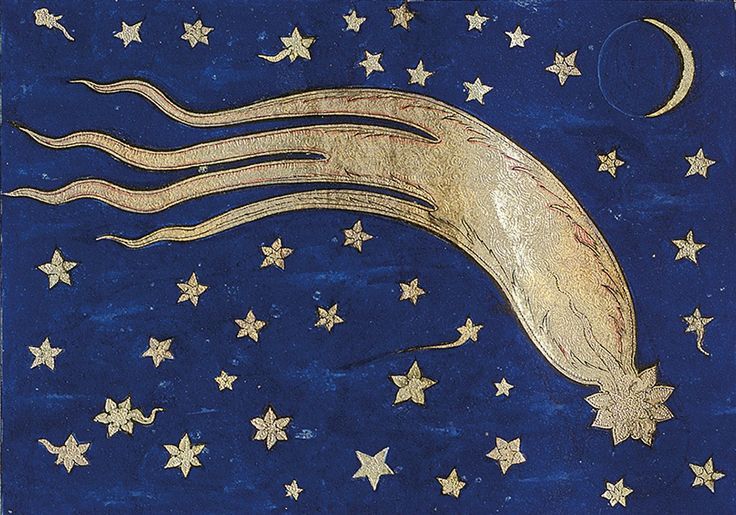
Artwork: Cantique des oiseaux comète


[i] Humbled-by-looking-up-at-the-heavens, WSJ, August 28, 2022

Alert: Beware of Sneezing Sponges

Dear Reader,

Each week I try to offer an insight or story that I have found valuable, hoping it will be useful to you.  I’m not sure if this week’s piece qualifies.  But I am going to go ahead and share a few reflections on an article from the August 10 “Science” section of the New York Times:

“Sneeze by Sneeze, Sponges Fill the Seas With Their Mucus”

Here’s the key thought: The researchers came across sponges sneezing snot while working on a project investigating the role played by sponges in moving nutrients through a reef ecosystem.

I wasn’t sure if I wanted to know more, but I kept reading.  Apparently, the sponges absorb needed nutrients as the sea passes by, take what they need, and in a slow spasm, eject what they don’t want back into the ocean.  A variety of organisms find this “contribution” exactly what their dietician recommended.

Sounds like an exciting discovery. But such knowledge did not come easily: The work required Niklas Kornder, another marine ecologist at Amsterdam, to spend a lot of time with sponges. “I would spend entire days just looking at the surface of them; it was quite boring,” he recalled.

I’ve heard of monks who spend years in silent meditation, hoping for great insights.  I had never imagined scientists spending their days staring at the surface of sea sponges.  But as many contemplatives know, enlightenment can come in a flash and with time-lapse photography they documented the slow sneezing.

The sponge has been around for at least 600 million years. “It’s the most successful animal that I know of, because it’s so old, and it’s everywhere,” said Jasper de Goeij, a marine ecologist at the University of Amsterdam

This is impressive. I know as I get older, it’s harder for me to go all the places I used to.  I can’t imagine being 600 million years old and able to be “everywhere.” Hopefully there will be carbon-free min-buses with ramps.

“This could give us hints of how early life evolved from these squishy brainless things into these complex organisms building spaceships,” Dr. Ushijima said.

In recent years, I’ve done my share of genealogical research on Ancestry.com.  Beyond my traceable human ancestors, I have always felt some deep connection with certain creatures. For instance, I was mesmerized by the old Johnny Weissmuller Tarzan movies as a kid and instinctively knew I had a deep kinship with Cheetah and all chimpanzees.  Growing up with dogs, I felt a personal bond with Lassie and Rin-Tin-Tin.  Loving to swim in the ocean, it was not hard to explain the sense of connection I felt with Flipper. But I never imagined I should include sneezing sponges in my lineage (although it explains why some Saturday mornings I feel like a “squishy brainless thing.”)  I doubt I have much to offer building spaceships. All I know is the next time I go to the beach I’m going to pack plenty of Kleenex.

Comments aside, isn’t the creativity and efficiency of the natural world amazing?

For the complete article, including time-lapse video of actual sponge sneezes, go to sea-sponges-sneezing.html

According to the article, “All three of these marine sponge species are probably sneezing right now. Credit…Benjamin Müller”

Old Haunts, New Rivers

            In late July, my wife and I traveled north to Sacramento to visit cousins, then on to the Oregon Coast to visit friends.  I was surprised with what perceptions arose in each place, and how the two impressions ended up blending together.

            I had lived in Sacramento in the mid-70s after college, trying my hand at selling real estate.  I made many friends, and grew to appreciate the river, the parks, the Victorian houses, and the neighborhood I lived near the Capitol.  I had not been back since. As we drove up the I-5, a lot of fond memories came back to me.  

We had booked a hotel in Rancho Cordova to be close to where we were going to meet for dinner.  As we came into the city and headed east on Highway 50, I was amazed at how much the city has sprawled and grown.  Logically, I knew the population had tripled since I had lived and worked there and there would be changes. But I was surprised at how out of place I felt.  

Memories kept coming as I thought of the people I knew back then and I wondered if I could trace them down.  But as I remembered each person, I realized I’d lost touch with them and that most of them, no doubt, had died.  It became clear that the life I had known was gone.

            The next day we headed north to Oregon.

Our friends’ home is on the banks of the Siletz River at a point where the river flows into the sea.  It’s a large, impressive river.  I realized that, growing up in southern California, I was familiar with seasonal creeks but no real rivers

Soon I was mesmerized as I sat quietly and watched the river flow.  I thought of our countless ancestors who have watched rivers over the centuries, and who sensed they were watching the unending movement of time. Day-to-day, we live as if our lives are stable. But days, months, and years pass, and we realize life has always been quietly moving all around us, and our lives are part of that constant movement and change.  

            The melancholy feeling of loss I had visiting Sacramento came back, but I saw it in a new light. I understood it was just another example of life’s river flowing.

            A verse from a 3-century old hymn began singing itself in my mind: “Time like an ever-rolling stream bears all its sons away; they fly forgotten, as a dream dies at the opening day.”  The hymn is based on a song of Israel, Psalm 90, which is itself 2,500 years old.  That sense of being part of “an ever-flowing stream” is an ancient awareness.

            A new thought arose: my time in Sacramento may have passed long ago, but many new people have come into that community with most of their lives are in front of them.  New lives have replaced mine and all who are no longer there.  And this is good.

            I kept watching the Siletz River. I could look eastward and imagine, at the headwaters of every tributary, the water’s journey just beginning. Then I could look westward and see the waters finding their way to the sea. The waters will evaporate, form clouds, and bring rain, and the river will replenish itself.  And this is good.

            I’m grateful for what I have seen and what I can still see. And knowing what endures is not me but the river itself.

Top Image: Siletz River looking eastward; image below: the river as it merges with the sea. Photo credit: R. Ellsworth

Playing in Life’s Jazz Orchestra

            A seminary professor once ended a class by offering a memorable metaphor for the spiritual life.

            Life, he said, is like playing in a jazz orchestra where the Divine One is both composer and conductor.  We’ve all been given a score for our life to play, as well as the freedom to play it as we want.  The composer’s aim to use every one of us to create an inclusive and beautiful work of music. 

At times, we may play notes not in the score. Maybe we do so by mistake because we are tired or confused. Or maybe we do so willfully, because we like to strike out on our own, regardless of the consequences for us or others.

 If this was a classical score, playing the wrong notes might ruin the piece.  But it’s a jazz score, always open to improvisation and the unexpected.  The Divine Composer takes whatever notes we have played and instantly rewrites the entire score to incorporate what we’ve done into something new, both for ourselves and others. And, as the composer is also the conductor, we are all invited to play our part in this newly revised score. In this light, no “mistake” is beyond an ultimate redeeming use.  The score is constantly evolving, but the divine intent – to use us all to create something new and beautiful – is unwavering. 

In this orchestra, none of us are mindless robots. All of us experience both the freedom to play as we want and the invitation to make something extraordinary when we follow the conductor’s lead and collaborate with others.

As we learn to trust the notes set before us day by day, we find a deep satisfaction in playing our life score as best we can, both for our own sake and the sake of the larger composition.  Of course, accidentally missed or intentionally misplayed notes can keep appearing, but never are beyond being incorporated into something wonderful.

One thing I like about his metaphor is that it assumes we have free will.  Other models seem to assume there is one, fixed, preordained plan for your life, which is a challenge to understand if we have free will. 

Another point: if we make some poor decisions and play off-key, we’re not thrown out of the group.  Every moment, every day, we are offered a fresh beginning and new music to play.

This model is not coercive.  We are not being commanded to perform or threatened with punishment if we refuse.  If we play it, it’s because we have decided we want to do so. We want to have our life count for something that includes a personal sense of satisfaction but goes beyond us.  Musicians often talk about what a thrill it is to make music with others, creating something exciting that’s more than the sum of the parts.  This is the key to a fulfilling life.

            It could be that the basic teachings of the great traditions – loving God, loving neighbors, caring for the earth, seeking justice, and lifting up those on the margins of life – are like musical scales and keys that are the foundation of every score.  But the genius of the composer is to use these in ever new ways while giving everyone an important part to play in bringing the music to its full potential.

Arguably the greatest jazz composer, arranger and conductor of all time was Duke Ellington.  Here’s a sampling of his wisdom that seems to fit well with I’ve described:

“A problem is a chance for you to do your best.”

“The most important thing I look for in a musician is whether he (or she) knows how to listen.”

“Everyone prays in their own language, and there is no language that God does not understand.”

This metaphor for spiritual life may not be perfect, but it’s as good as any other I’ve encountered.

Photo Credit: Maria Schneider Jazz Orchestra, Blue Note, Tokyo

How Vin Scully Endured Personal Tragedies

            Many people are writing tributes to the sports announcer Vin Scully, who died this week at 94.  He was the “voice of God” for me and many kids with transistor radios when we were growing up — he was omnipresent, trustworthy, forgiving and always positive. His endless tales of players’ backgrounds were told with reverence and affection.  He was a constant in my life over six decades.  Beyond the famous baseball moments he was part of, I have several other enduring memories.

In 2010, I was in Phoenix for spring training.  After the game, I was exiting behind the stands and happened to see him walking alone as he headed toward his car. He was dressed in a well-worn suit, and I remember thinking he looked older in person than he did on television. 

In 2016, my youngest daughter, her fiancé and I made a pilgrimage to “Vin Scully Day” at Dodger Stadium where we heard him sing “Wind Beneath My Wings” to his wife and 54,000 reverent and faithful fans.

            We all knew he was a very private man.  I vaguely knew his first wife had died and he had remarried, but I never heard him discuss it.

            The one exception came in 2008, when he was interviewed on KCET along with UCLA Coach John Wooden.  At one point, the interviewer changed the topic from sports to personal challenges. He noted that Scully’s first wife had died suddenly at age 35, leaving him with three children.  He’d remarried Sandra, a woman with two children of her own, and together they had one more child.  Later his oldest son died in a helicopter crash at age 32.  Vin was asked how he had gotten through it all.

He said creating a new family after the death of his wife while working full-time was very hard – not the amusing experience of blended families being portrayed on the “Brady Bunch” TV show at the time.  He didn’t go into the loss of his son.  But he concluded by saying the only way he got through it all was to “stop asking why.”

Asking “Why?” is a perennial human question.

“Why did that person have to die when they did?” we ask.  The answers people find are varied. Some attribute it to the intentional act of an inscrutable God.  Others theorize it must be “karma,” a kind of moral accounting system in which we inherit debits and credits from past lives that shape our personal fate.  In modern times, we may look to causes that can be objectively verified, such as family history or the actions of viruses, bacteria, and natural forces.  We may find fault in the way a car is designed or blame a toxin in our food supply. 

We are curious, intelligent creatures, and we yearn to find answers for personal losses and tragedies.  Sometimes we find them. Such answers may bring some peace, and we are reassured that the universe isn’t chaotic after all.

But satisfying answers don’t always come.

Vin’s first wife died of an accidental medical overdose. That’s explainable on one level – simple chemistry. But that doesn’t take away the heartbreak, sorrow, and unfathomable reality that one day a young wife and mother of three is alive and well and the next day she is gone.

His son died working as a helicopter pilot, which may be attributable to a simple error in judgment of a person up in the air at the helm of a large and complex machine.  But the harsh reality that a remarkable young man whom you’ve loved since birth is here one day and absent the next – that will always be a shock.

Vin did, at times, talk about the importance of faith and prayer. He was raised a devout Irish Catholic and remained one his entire life.  His immersion in that faith made a difference in how he endured and how he lived. But he never claimed that any of his prayers helped him find an answer to the question that apparently haunted him in the early days of his grief — why did death come to these two beloved people in such an untimely way?  Vin — the gracious, wise, humane, and compassionate observer of so many human encounters — said the key for him to going on with his life was to “stop asking why.”  I will remember that.  And I will also remember what a joy it was to turn on a radio and hear him invite us all to pull up a chair “wherever we may be” and listen to a master storyteller at work.

Photo credit: “Dodgersway”

Honor and Trust: What a Gift

This week we are on vacation at the little town of McCloud near Mt. Shasta in Northern California. We first came here 12 years ago on a yoga/hiking retreat, and have become quite attached to the area and the people. One of my favorite activities is to play at the historic 9-hole golf course. This sign captures the spirit of the course and the place. In a small town, people can operate on honor and trust. What a gift.

A-C-T-S: A Simple Form for Personal Prayer

Decades ago, I came across a simple structure for personal prayer I’ve since used countless times. This prayer form is one that works well when you want to pray for the needs of others (the “Serene Light” prayer I wrote about last week is more of a meditation). I like the way it moves from point to point and how it is easy to remember and adapt. When I complete it, it feels like I’ve covered the important bases.  It’s uses A-C-T-S as an acronym … Appreciation, Confession, Thanksgiving, Supplication.

The ACTS prayer will be familiar to some, but I’ve adapted it to make it my own. I start with “Appreciation” rather than the traditional “Adoration.” I avoid stock phrases about God, and don’t dwell on “sin.” My focus is on moments of personal awareness leading to the needs of others. What I’m offering is my own, custom version, not the standard one.  Adapt it as you like.

APPRECIATION – Some prayers start with something like, “Thank you for all my blessings,” but that general statement doesn’t capture actual moments to be savored.  Instead, I begin by recalling at least seven recent experiences I’ve had that feel like blessings – tangible reminders of how good it is to be alive, even amid difficulties.

         Here’s seven moments that came to me recently:

  1. My breakfast Thursday morning — that toasted half of a poppy seed bagel with cream cheese and the last of the smoked salmon.
  2. The lunch I had yesterday with A., catching up on two years of each other’s lives.
  3. The hour my wife and I spent with our seven-month-old granddaughter on Wednesday. She cried because she missed her mom, but the smile on her face when mom came back was something to behold.
  4. Completing the first six weeks of the interim pastoral work I’m doing and meeting new people.
  5. The swim in the ocean I had last week, knowing the ocean where we live is not always warm enough for an old guy to enjoy.
  6. Going to the fish market yesterday and buying fresh yellowtail, grilling it, and eating it.
  7. A good night’s sleep last night — only awoke once.

If we don’t stop and intentionally remember these kinds of blessings, we can easily forget them, and they’ll be lost.

CONFESSION

         I don’t make this into a time to grovel or heap guilt on myself, but to simply reflect on the last few days to see what regrets come to mind…things I said or did, or opportunities to do better that I missed; e.g., “The moment when I lost my patience when we were moving furniture the other day.”  It’s taking an inventory of my behavior with the aim of doing better in the future, but not getting stuck in regret.

THANKSGIVING

         I use this prompt to express gratitude for the divine presence in my life that is always ready to receive my “confession” in a way that encourages me to keep learning how to live.   “God does not love as we love,” the French mystic Simone Weil said, “God loves as an emerald is green.” I take a moment to accept the divine compassion.

SUPPLICATION

         Here’s where I turn to specific situations or people that I want to pray for.  Like the “Metta” prayer in Buddhism, it begins with personal concerns and then moves outward to situations beyond me.

         I begin by visualizing our youngest daughter, her fiancé, and his family. I ask they be surrounded with divine light, strength, and goodness.

         I turn to our middle daughter, her husband, each of their three children, and then to members of his family with the same request.

         I pray for our oldest daughter, her son, and her ex-husband.

         I see my wife and ask for her to be blessed.

         I turn to myself, focusing first on my health, my personal journey, and whatever work or projects I’m involved in currently.

         Sometimes I shift to members of our extended family who are on my mind.

         My attention then moves to specific people I know who are facing health issues, depression, important decisions, or uncertainty.  This may be personal friends or situations I have learned of recently.

         I end by imagining my mind being clear and open and being receptive for any intuitions, prompts or ideas that may arise.  If I sense something, I note it, but I’m not straining for anything…just making my consciousness available.   

         When I’m done, I may simply bow my head and silently say, “Thank you.”

         I’ve used this ACTS prayer form many times in my life.  It’s particularly fitting to do after yoga or some mindfulness practices.  Like the “Serene Light” prayer, I’ve used it on airplane flights, sleepless periods in the night, outside of hospital rooms, and in quiet times in the morning – any place or situation when I would like to center myself in gratitude and compassion for others.

         If we are turning to prayer because we are worried about something or someone else, we may feel tempted to skip the first three parts and get to “supplication.”  But I’ve found taking each step in turn puts me in a better place to pray for others rather than just rushing there right away.

Does it make any difference? Who knows! I’ve been surprised by how many times I’ll bring a familiar concern to mind and realize something good has occurred since the last time I prayed for it. But not always. It’s not magic. 

I remember a story about CS Lewis.  A friend was skeptical that praying accomplished anything and said examples of “answered prayer” describe positive outcomes that are, in fact, just coincidences.  Lewis responded, “Maybe so, but the funny thing is, the more you pray, the more positive coincidences seem to happen.”

Turning Towards the Serene Light

         In my lifetime, I’ve explored many kinds of prayers, meditations, mantras, mindfulness techniques and awareness exercises.  I’ve used them to help me on my personal journey, to occupy myself at night when I can’t sleep, to center myself before walking into difficult situations, and to share them with others in classes and retreats. One ancient prayer I keep coming back to is the “Serene Light” prayer.  Some of you may already know it. I want to share it and include some personal comments.

         This prayer arose in the Eastern Orthodox tradition centuries ago. In the simplest sense, it uses light as a metaphor of the divine presence – light in darkness being one of the most common metaphors in global spiritual traditions.  It’s not dependent on you believing any specific religious doctrines, but only on a simple desire for a spiritual connection.

         Like many prayers, its effectiveness depends on our intention — the way in which we recite it.

A writing teacher once said that the difference between prose and poetry is that good prose keeps you moving from one idea to the next, speeding up as you go along.  Good poetry – and prayers — are different.  They invite you to slow down, pause and think about what each phrase means, letting it linger and speak. It’s like putting flower petals on water one by one and watching each one float before you add the next one. Or sipping a good glass of wine instead of gulping it down.  The “savoring” approach lets each image or thought take shape and sink in; our sense of time slows down, which eases us into a more reflective state of awareness.

So, here’s the prayer, followed by some of my comments on each phrase:

Serene light,

shining in the ground of my being,

draw me to yourself.

Draw me past the snares of the senses,

out of the mazes of the mind.

Free me from symbols, from words,

that I may discover the signified,

the word unspoken,

in the darkness,

which veils the ground of my being

  • “Serene light” – the light I seek is not glaring or flashing, but calm and quiet. It radiates peace and strength. It is unaffected by my fears and anxiety. In the mystical traditions this light is at the heart of all creation. 
  • “shining in the ground of my being” – In one way, this light is beyond the busy-me that chatters all day. But in another way, it lies deep within me, at my center.  It shines, and in so doing offers me a focus, a goal, and a presence.  I imagine it shining within me.  
  • “Draw me to yourself” – Like a thirsty animal seeking water during a drought, I affirm my desire to come closer to this light.  I am not asking to abandon my own sense of self or avoid my responsibilities. But I want some help, some aid, some infusion of peace as I face what is before me. I trust the light will help me.
  • “Draw me past the snares of the senses” – We are wired to have our attention react quickly to many kinds of stimuli.  If I see something move, my eyes immediately evaluate what it is. If I hear a sound, my brain is compelled to analyze the source.  The same is true of all my senses. I can spend every minute of the day being subject to these distractions, becoming “ensnared” in the constant flow of information. But in this moment, I want to slow down, reduce the mental static, and not give in to distractions. I am choosing instead to seek the light.
  • “…Out of the mazes of my mind.” Just as my senses can keep me constantly distracted, so my mind is in the habit of jumping from one thought to the next, creating strategies and scripts to protect or promote myself.  But right now, I want to ascend above the clouds to see a greater horizon; I want to rise above the “mazes”.
  • “Free me from symbols, from words…”  Most moments of awareness are dependent on ordinary things and familiar concepts, but we can reach beyond them. In this prayer, I am using symbols and words like “light” and “mazes”, but those are not my goal. Beyond my cluttered, ordinary thinking is something greater I can sense when I am still.
  • …that I may discover the signified, the Word unspoken.”  There are endless names for the divine; Islam alone offers 99. Each word suggests a specific spiritual experience and relationship, but all are limited to a specific aspect of our understanding.  In saying this prayer, I want to go beyond all language and move closer to the “serene light.”   Ultimately, I seek the source of the light, which I cannot fully know. But I don’t need to “know” it in an ordinary sense — I only need to draw close to it.
  • “…in the darkness which veils the ground of my being.” The darkness is not a forbidding or dangerous darkness — it’s “dark” because I can’t ever “see” the “ground of my being” as I can an everyday object.  It’s the mysterious dimension in which our souls exist.

It’s ideal to memorize the prayer so it’s available whenever we want it.  And it’s important to know that we don’t have to look for immediate results to experience its power.  Sometimes it’s enough to have taken the time to live within the prayer for a set time, and the effects may be experienced later in the day.  If you do have specific concerns on your mind, you can add those requests after you’ve taken the time to dwell in the prayer; coming from a more peaceful inner space helps us focus what it is we seek.

The “Serene Light” prayer is a gem that I’ve turned to again and again and have always been grateful for where it leads me.  Perhaps it can also be useful to you.

Image: Spika Star, New Forest Observatory

What To Do With a Prized Salmon? (a summer rerun)

(Dear Reader: We are in June Lake for a family gathering this week, so I’m not composing something new. But I thought I’d re-post one of my first pieces that reminds me of the importance of savoring the natural world. Remember The Old Days, when there were “summer reruns” of TV shows? — Steve)

The second congregation I served was in Wapato, Washington – a town of 3,000. George Palmer was retired and drove an older white pick-up truck. An experienced tradesman, he liked to go around town and do household repairs for people who could not afford to have things fixed. He took delight in his small white poodle, Taffy, and had built a special car seat for Taffy so that she could sit next to him and see where they were going. George and Taffy would often stop by my office to visit.

             He told me once about being a child at World Series time.  Radio
broadcasts had not reached rural Washington yet, so everyone who wanted to follow the game would gather in downtown Yakima in front of the offices of the local newspaper, the Yakima Herald. There was a scoreboard with a baseball field painted on it, and as the office would get updates, an attendant would move figures around the field to show and post the scores.  He said it was exciting every time an update came, and the crowd would stand in the street to follow the games for hours.    

             George was also an accomplished fisherman, particularly for salmon.  One time we were talking about fishing, and I asked him what the biggest fish was he ever caught.  He told he had been fishing with friends on the Columbia River, and he hooked what was clearly a huge salmon.  It took him some time to get it close enough that he could net it.  He said when it was within arm’s reach, he realized it was the most impressive fish
he had ever seen.        

I said, “So what did you do with it?
           “Steve,” he said with a smile, “It was so beautiful I just had to let it go.”

So much of our culture is about gaining control over things and making them our possession.  In that moment, I realized that perhaps the best thing we can do is to give thanks for a shining moment, and then let it go.

We’ve All Come to Look for America

            You might know the song, “America,” by Paul Simon. It’s based on a road trip he took with his girlfriend in 1964. Here’s the last stanza:

Cathy, I’m lost, I said though I knew she was sleeping
And I’m empty and aching and I don’t know why
Counting the cars on the New Jersey Turnpike
They’ve all come to look for America
All come to look for America

I have always believed that the essence of America is The Dream: the creation of a society where all human beings “…are created equal, and endowed by their Creator with certain inalienable rights, and among these are life, liberty, and the pursuit of happiness.”  The Constitution, the Bill of Rights, and a shared commitment to human dignity, democratic processes and the rule of law are the means of fulfilling that dream. 

            But there are times when I wonder if I’m naive.  

            In 2010 I attended a conference in Washington, D.C. and visited the Capitol. In the rotunda I viewed eight paintings featuring great moments in American history, including the signing of the Declaration of Independence.  I then turned to the “Frieze of American History,” a fresco depicting 19 other scenes.  Many scenes were ones I expected.  But I was surprised by others: Montezuma greeting Cortez like a God and Juan Pizzaro conquering the Inca people in Peru in search of gold. What are these scenes from Latin American colonial history doing in the U.S. Capitol? As I thought about it, it seemed obvious: the artist understood America as the supreme example of the hemisphere-wide history of Europeans conquest.

We don’t have to look too far in our recent history — from the January 6 attack on the Capitol to the mass shooting at the supermarket in Buffalo – to see that, for some, “the Dream” is not as important as the conviction that, beneath the rhetoric, “America” is really about the continued dominance of a specific group.

            So, if we “look for America,” what do we find? The Dream? Or just another country controlled by a particular tribe?

I remember being in New York for our oldest daughter’s college graduation.  Our two younger daughters and I took the ferry to Ellis Island.  We entered the reception area and saw a large collection of historic luggage on display– suitcases, satchels and woven baskets reflecting cultures from around the world.  We went into the waiting room where wooden benches are arranged end-to-end in parallel rows, so new arrivals would move up one row and down the next until it was their turn to be processed.  We sat on a bench looking out on the Statue of Liberty and read it was one of the actual benches used in the early 1900s.  My maternal grandmother had come through Ellis Island as a 21-year-old in 1912, speaking no English. Her passage had been paid by a family friend living in Riverside who would sponsor young people in exchange for two years of domestic service. I realized she may have sat on this very bench. I never knew her – she died before I was born – and I wished I could ask her what she might have been ‘looking for” when she made the trip by herself. I thought of all the opportunities and blessings my family and I have known – far beyond anything she could have imagined.  This was a moment when The Dream seemed real.

            I remember a 4th of July picnic in Yakima, Washington.  We had become close to several Filipino families in my congregation, and they’d invited us to celebrate the holiday with them.  There is a proud tradition of oratory in Filipino culture. The father gave the first speech, and eloquently described his dream of coming to America, all the obstacles he had to overcome, and how grateful he was to be here with his family.  Then one of his daughters spoke. Soon after she arrived, she had enrolled in the local community college to earn a teaching credential. One instructor told her she would never be a good teacher because her accent was too strong.  In that moment, she said, she became determined to prove him wrong. By the time we knew her, she was an official “Master Teacher” and universally respected in her profession. Being present for these testimonies made me feel closer to the meaning of the 4th of July than any fireworks display.   This was a moment when The Dream seemed real.

            On the day in 2010 when I visited the Capitol rotunda, my walk back to my hotel took me past the White House. There was a black family dressed in African apparel looking through the fence. The Obama family was living there at the time, and I tried to imagine what it felt like for this family to know that.  This was a moment when The Dream seemed real.

            I think of a Muslim grad student from Egypt who became a good friend.  He described what it was like to grow up in a country with a corrupt and repressive government, and how thrilled he was to become a US citizen. “Do Americans realize what an amazing thing the Constitution is?” he asked.  This was a time when The Dream seemed real.

            I’ve never “counted the cars” on the New Jersey Turnpike or Interstate 5, and it’s been a long time since I’ve ridden a Greyhound bus.  But I think about our country at this time in its history.  We’ve “all come to look for America,” and the quest may never end.  But to me, it’s all about The Dream.