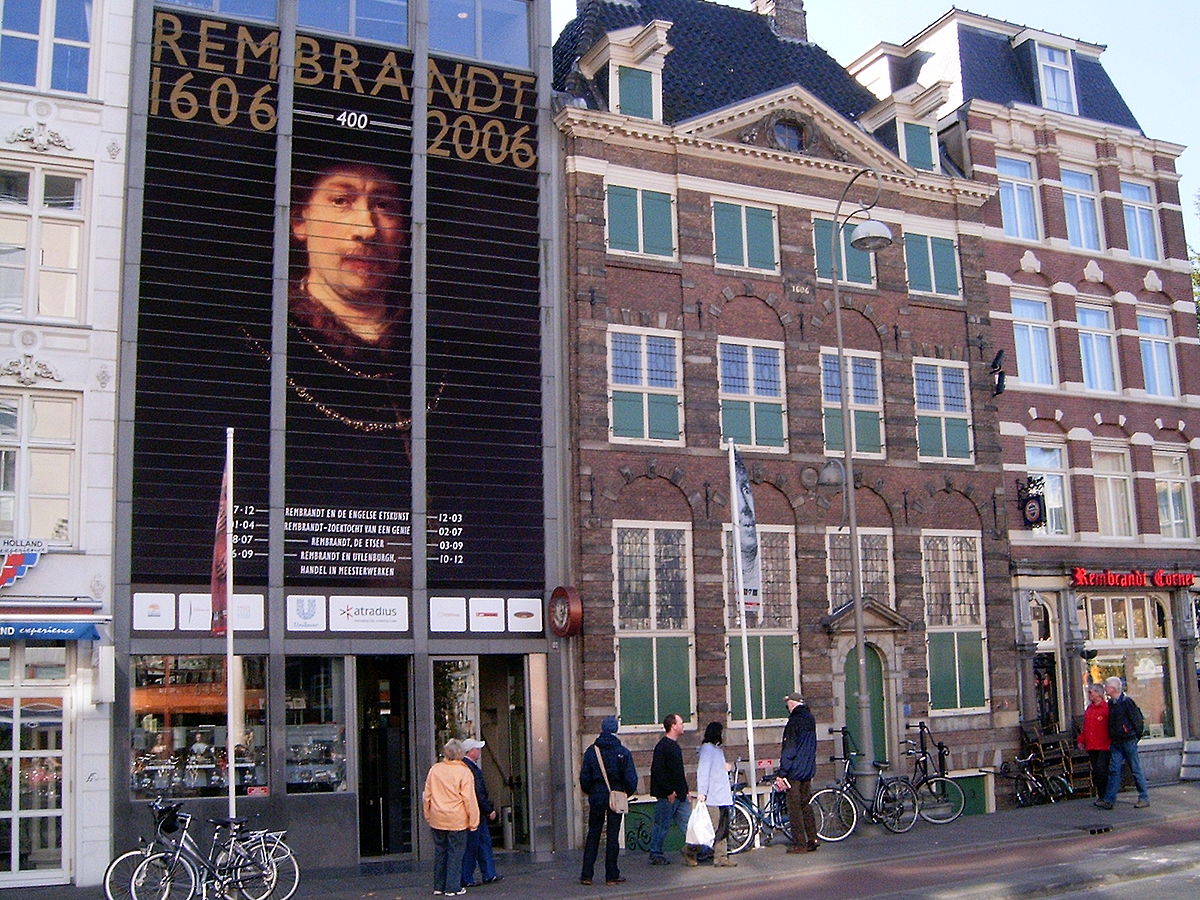
Like many houses in the old section of Amsterdam, Rembrandt’s overlooks a canal. Not far from his doorstep, ships from all over the world were coming and going, bringing with them a great diversity of people at all stages of life.
Entering on the first floor and progressing upward on narrow stairways, you see what his life was like – how the food was prepared, where his maid slept, where he received guests and where he worked. Here is the room he lived in and his bed:

As you move through the house you relive the different stages of his career – from his early days making a name for himself to the period of his great success, both as an artist and art dealer. But his last years were difficult. As we came towards the end, this sign intrigued me:

I became fascinated with this description:
A new style is taking shape.
Rembrandt now paints many single figures lost in thought.
Movement gives way to rest.
There is inner tension though.
And he works more loosely, with broad brushstrokes.
I was intrigued by the phrase, “lost in thought.” No matter what age we may be when we experience such a state, it doesn’t mean we aren’t thinking; we may in fact be thinking a great deal. In our everyday, routine experience we direct our thoughts where we want them to go but, in these moments, we just aren’t sure where to go, or how the pieces of our life can fit together; it’s as if our thoughts don’t know where to land. Some might say we are “spaced out” – but in fact we may be “reaching in.”
When I returned home, I read more about this period: Rembrandt’s last years were the most difficult of his life. He was effectively declared bankrupt in 1656; a picture commissioned for Amsterdam’s new Town Hall, the largest he ever painted, was installed and then replaced in 1662; his lover, Hendrickye Stoffels, died in 1663, and his son Titus, at the age of 27, in 1668. At one point he was so hard up that he had to raid his daughter Cornelia’s money box.[i]
A friend told me of a conversation he shared with a man who had been a wise spiritual mentor. This man was in his 80s at the time and had outlived his wife and many others. My friend asked him, “Has anything surprised you as you reach this stage of life?”
“I wasn’t prepared for the amount of loss,” he said.
Over time, we lose people we love. Periods of success in our working life can seem far away. We might remember times when life was going well, following a script we were writing in our imagination at the time. But unexpected events occurred that we couldn’t change, and our script had to be rewritten. How did this all happen? Did it have to go that way?
We can become “single figures lost in thought.”
Rembrandt’s specific spiritual beliefs aren’t known. We do know his personal life didn’t conform to the religious establishment of his time: “The artist’s eccentricities and irregular, unwed lifestyle may have put him beyond the pale of Amsterdam’s stuffier and more conservative circles… but his engagement with biblical themes was lifelong and his last years gave rise to some of his most thoughtful and unusual interpretations of them.”
I’m drawn to two of the paintings from this period.
The first is “Jacob Blessing the Sons of Joseph,” created in the 1656, the year he declared bankruptcy. In the Biblical story, two of Jacob’s grandsons are brought to him for the family blessing with the expectation that he will bless the eldest with his right hand. But instead, he blesses the younger:

Here is a close-up of Jacob’s face:
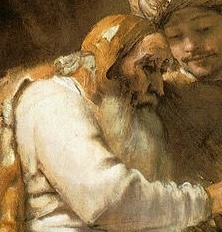
I don’t think he’s looking at the grandsons – he’s looking both beyond them and within himself. What does it feel like to know your life is almost over, wanting to do what you think is right for your family, but realizing you will never know how it will turn out?
“Simeon in the Temple” is his last painting, unfinished at his death in 1669. It is another story of an old man blessing a child. In Luke’s Gospel, Mary and Joseph bring the 8-day old Jesus to the temple for dedication. Simeon believed he would be able to bless such a child before he dies:
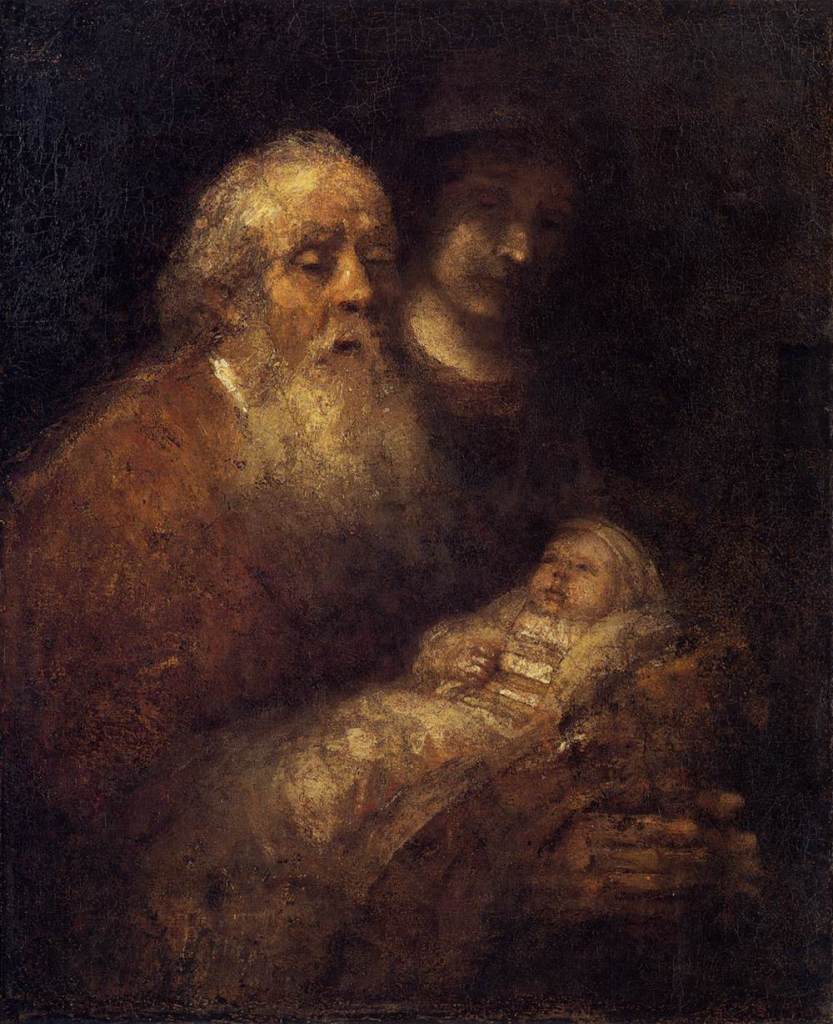
The infant child is looking up at the old man and seems to truly “see him.” Simeon is holding the child with tenderness as he gives the blessing, but where is his attention? Like Jacob, he seems “lost in thought.”
Rembrandt didn’t have life figured out. Most likely he was “not prepared for the amount of loss” he had experienced. But these late portraits convey a reverence for these people in their private moments, a tender love and respect. That, to me, can be more “spiritual” than having simplistic answers to life’s challenges.
When we see someone “lost in thought,” may we summon that same reverence for them as Rembrandt did. And when we are in such moments ourselves, may we know that in some mysterious way we are not alone.
[i] https://www.nytimes.com/2014/12/04/arts/international/rembrandts-turbulent-final-years.html

 Steve Jacobsen, Ed.D
Thank you Steve. Greg and I are in Ireland and currently visiting Belfast. We toured the Titanic museum yesterday …. A very moving experience which left me reflecting on what life is all about and remembering that wonderful song “What’s it all about Alfie?” I turn 72 in a few days. I have been lost in thought a great deal of late. What is life all about given the number of hellos and goodbyes we are confronted with throughout our life. I don’t know. I guess I’m in good company. ❤️
LikeLike
Kathleen,
Thank you so much for the note.
I did know there was a Titanic museum…I appreciate what you say about it.
I have not been to Ireland except last month when I flew Aer Lingus from AMS to SFO…just two hour layover, but I still enjoyed looking out my window.
I turn 72 in 3 weeks…Happy Birthday and thanks again.
Steve
LikeLike
this is my second visit … Roy and I were here in 1997. I would encourage you to visit Ireland!
LikeLike