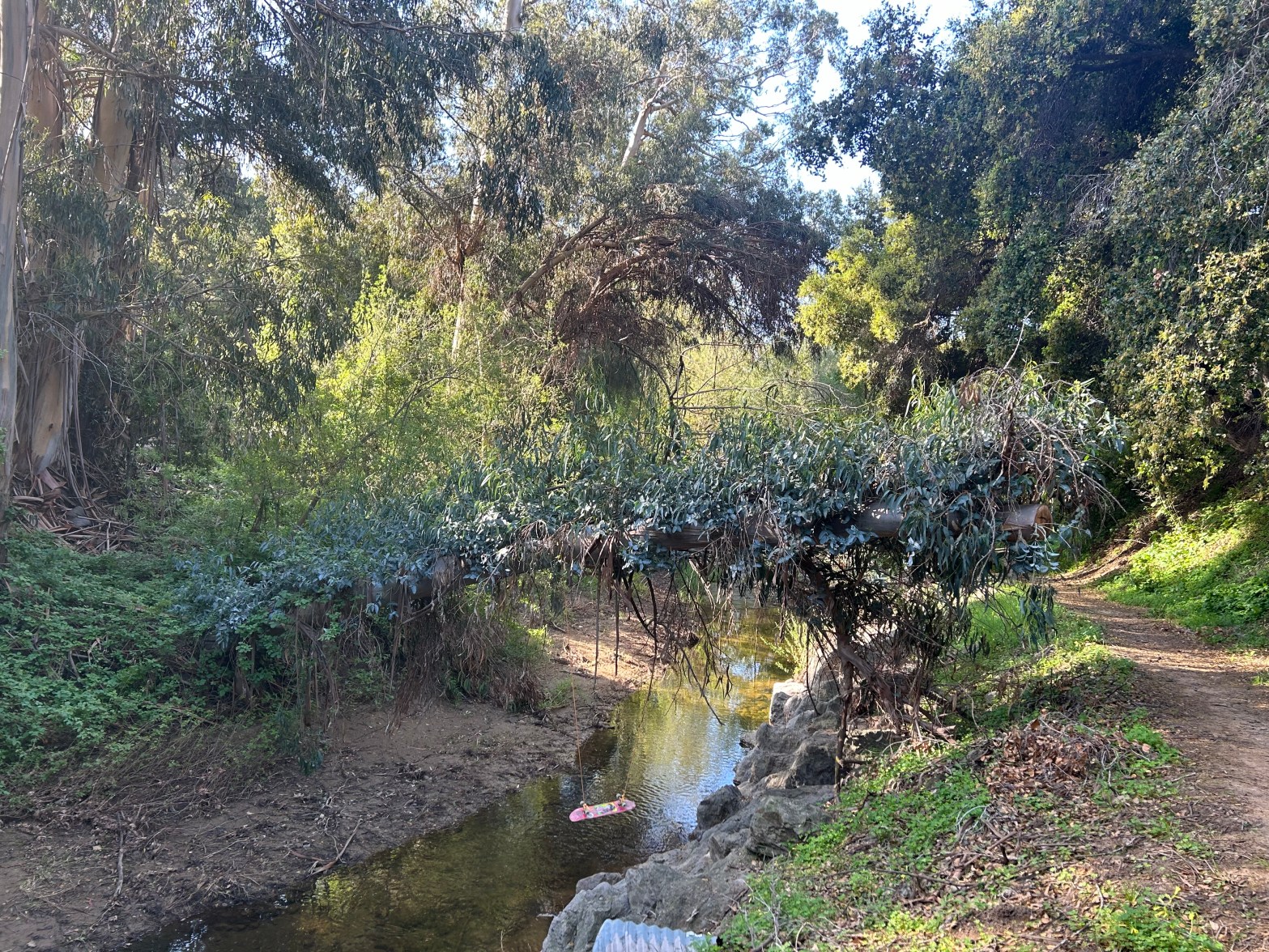
We’ve had some intense rainstorms in Santa Barbara in recent years which have caused many trees to fall. This eucalyptus fell over San Jose Creek several years ago. I see it every morning when I walk over the bridge near my home. When it fell, one of its branches landed on the ground on the opposite side of the creek and became a support for the rest of the tree:

I’ve been fascinated to watch new growth rising skyward from the fallen branch. I remind myself that this branch began its life going vertical, then fell to its current horizontal position. But that unexpected event did not change its purpose — it’s thick with new growth.
I recently came across this poem from Catherine Abbey Hodges who lives in Springville on the western foothills of the Sierras. She witnessed something similar in her “neck of the woods:”
After the Flood
They looked like goners,
the cottonwoods and alders
downed when the river
went wild. And no wonder:
for two days we’d heard
the boom of boulders
above the water’s roar,
heard the crash and snap
of sturdy trees.
But now they’re sprouting
branches, new green
thrusting skyward
from prone trunks.
It’s a strange sight, hopeful
though not yet beautiful,
this ungainly resurrection,
early days of a miracle
etched in the seed.
I kept rereading the last stanza:
- such trees are indeed a “strange sight” – something that defies our everyday expectations.
- It’s “hopeful though not yet beautiful” — it’s impressive not because it fits some pre-determined idea of what it should look like, but because it demonstrates the raw power of hope.
- It’s an “ungainly resurrection” – it looks more clumsy than graceful, yet the impulse to thrive and be reborn shines.
- This “miracle” is manifesting itself day after day, but the power to do so was given long ago when a regenerating life force was “etched in the seed.”
I began to imagine how such trees are metaphors for the lives of many people I’ve known in my life and career.
Most of us begin life full of optimism, confident we will keep growing according to our plan as we reach for the sky. But storms come. Branches break. We fall. It’s tempting to give up. Can we find some new way to live?
The German mystic Meister Eckhart said, “The soul grows by the process of subtraction.” I take this to mean that when we are full of our selves and rigid expectations, there’s no room for soul. But when losses come and we break open — as our illusions are “subtracted” from our sense of self — the divine Spirit comes near to offer us a chance to experience new life that is “etched in the seed” of our soul. We may never stop grieving for what we’ve lost along the way, but shoots of regeneration begin appearing.
In my Goleta congregation, we would have annual retreats called “Crossroads” which would include 15 or 20 people. We’d begin Friday night by sharing a meal and getting to know each other. On Saturday morning we’d study a story from Scripture that I had chosen for its potential to offer insight into the experience of living. I’d then give everyone a large sheet of newsprint and a box of markers and ask them to go off for two hours to create a “life map” — a visual representation of how their life had unfolded. People would often draw a winding pathway with many ups and downs, then draw pictures or choose words to describe key events. (Some of our engineers were more comfortable with bar graphs.) You’d see things like, “depression” or “fell in love” or “divorce” or “new job.” When people were finished with their maps, I’d ask them to go back and mark any places on their road where they encountered God.
We’d regather. Each person had a turn describing their map and journey. They would then tape their map to the wall of the meeting room. When everyone was done, we’d take time in silence to survey the range of life experiences in our group. There was always a sense of awe at what people had been through and how, in many ways, they’d experienced unexpected growth and blessings.
The human spirit is like a seed, and etched into it is the potential to heal, integrate, grow, and adapt.
I once traveled with a group to Ghana. In many cultures, if someone asks, “How are you?” the response is something like “I am well” or “I am fine.” But our host said when someone in Ghana asks, “How are you?” a traditional response is “Yesu Adom,” which means “By the grace of God” or “By the grace of God I am well.”
I imagine standing on the San Jose Creek bridge asking my friend, “How are you doing, Fallen Tree?” I would not be surprised to hear: “By the grace of God, I am well. I have not given up. I am determined to thrive. Join me.”
By the grace of God, I will. May we all.
“After the Flood” by Catherine Abbey Hodges in Empty Me Full. (forthcoming by Gunpowder Press, 2024) Used with permission.

 Steve Jacobsen, Ed.D
So beautiful, thank you.
LikeLike
Thank you for the comment Pat! Hope to see you at the HSB event.
Steve
LikeLike
I lived along San Jose creek for ten years. When the big storms caused the boulders to roll down the creek, it was so impressive and memorable. Rather than thinking of renewal, I usually thought about mountains and how the weather will dissolve them over time. Does that mean I’m a pessimist? 🙂
LikeLike
What an amazing process that mountains can dissolve over time. But “nature refuses to be embalmed.,” and who knows what will take their place.
I did not know you lived by the SJ Creek. It’s so awesome to see and hear the winter storms fill the creeks.
Always great to hear from you. Steve
LikeLike
Jesu Adam.
<
div>And you?
<
div>
<
div dir=”ltr”>
<
blockquote type=”cite”>
LikeLike
What a joy to be reminded of CrossRoads. What privilege tl have been a part of it. What a blessing to have you share it in this context.
LikeLike