
Recently, my attention has been captured by birds sitting calmly by themselves. Sometimes it’s in a tree in our backyard. Sometimes it’s on a telephone line in the neighborhood. We are both away from our fellow creatures and neither of us is in a hurry. It’s as if we are sharing a contemplative moment.
As an example, a sparrow joined me in my quiet time early this past Tuesday morning. It perched on a branch about 15 feet away from where I was sitting and stayed there. I found myself wondering if she (or he) and I had found a shared wavelength. I couldn’t help but ponder: What is that bird thinking about? It’s not singing or building a nest or foraging for food or looking anxious. It’s just sitting there. Is it sensing things beyond my awareness, like the earth’s magnetic fields or subtle shifts in the weather? Is it hearing sounds beyond my capacity and assessing them?
A meditation teacher once said that our body is always in the present moment, but the mind is a time machine – jumping back and forth between the past and the future. One goal of meditation is to let our mind settle into our body so it can dwell in the present. When we do that, we can become open to an inner awareness that opens us up to subtle forms of knowing.
If you have a dog or cat, you know they can spend a long time sitting in an open doorway looking out. I can get impatient. I’ll say, “Well, which is it? In or out?” Then I get a glance that seems to say, “Is it not acceptable for me to just sit here?”
My doctoral dissertation explored what spirituality might mean to 22 leaders in secular organizations identified by their colleagues as ethical and effective. One of my seven questions was: “Describe what part, if any spiritual traditions have played in the formation of your values, beliefs, ethics.” One Native American woman, who led a large social service agency for her tribe, wrote: “My parents had strict behavior expectations for my sisters and brothers. This included being aware of and respectful of the traditional cultural and religious teachings, customs and beliefs of my people. This included the need to be aware of one’s inner self and to do those things to strengthen one’s inner self, so that one’s life would be in balance. This included time alone, meditation, being quiet, listening, and being respectful of others need to do the same.”
I remember reading her response with amazement – and envy. No one taught me how to be quiet and alone. Did anyone teach you?
When I was at Hospice of Santa Barbara, one of our Spiritual Care Counselors was working with a woman who lived alone and was dying of cancer. The woman had a strong Buddhist meditation practice and was content to spend most of her days in solitude. Our counselor established a rapport with her, and at times they would meditate together. The counselor got a call from the woman’s brother in Minnesota. He was on the staff at the Mayo Clinic and a devout Christian. He said he had offered to come to Santa Barbara to be with his sister. Though they were close, she declined. The brother asked if there was anything he could do. After some thought, our counselor suggested that he and his sister pick a time every day when she would be in meditation, and he could set aside that exact ime to pray for her (adjusting for the two-hour time difference.) After the woman died, the brother contacted us to say how grateful he was for that suggestion. Up to the time of her death, in that coordinated silent practice, they felt a deep connection despite the distance.
St. Francis was famous for preaching to the birds. I wonder how much time he spent with them in silence before he knew he had something to say.
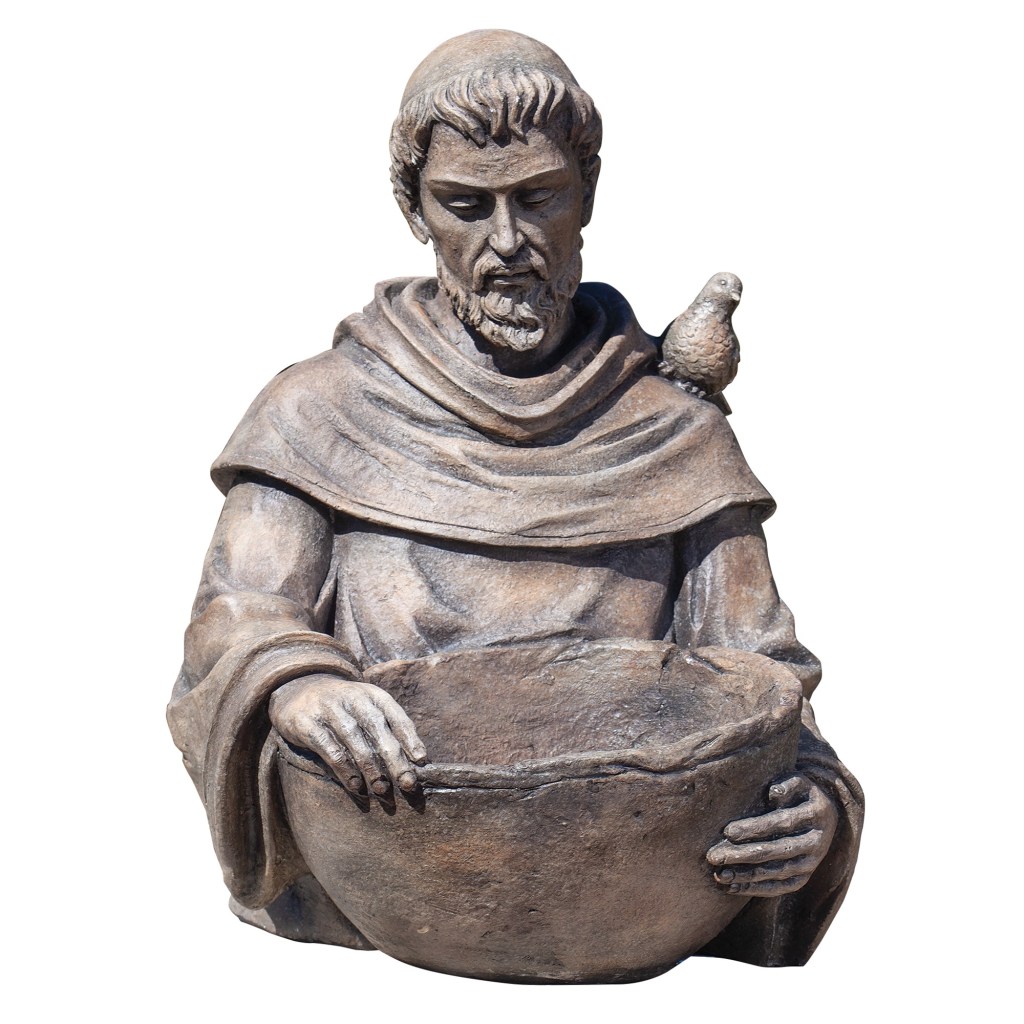
Image: “St. Francis Bird Bath Bowl,” catholiccompany.com

 Steve Jacobsen, Ed.D
beautiful Steve. I’ve always loved that image of St. Francis with the bird on his shoulder. Perfect illustration for this wonderful piece.
LikeLike