Our “Immemorial Feelings”

               A writing teacher once said the difference between prose and poetry is that good prose keeps our attention moving forward, while good poetry causes us to slow down.  I recently came across this poem by Wendell Berry.  I had to look up a word I did not know, then re-read it several times to appreciate what it offers. It was worth the effort:

It’s the immemorial feelings

I like the best: hunger, thirst,their satisfaction;

work-weariness,earned rest; the falling again

from loneliness to love;

the green growth the mind takesfrom the pastures in March;

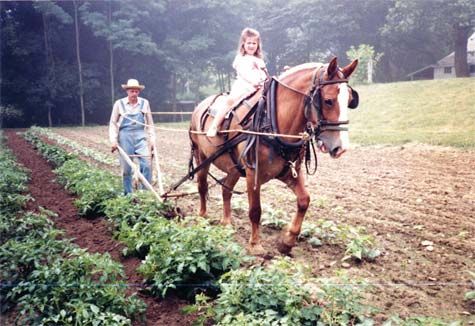
The gayety in the strideof a good team of Belgian mares

that seems to shudder from methrough all my ancestry.

— “Goods” by Wendell Berry, New Collected Poems, 2012.

               What does the word “immemorial” mean?  According to the Cambridge Dictionary, it describes something that has been “existing or traditional for an extremely long time;” e.g., “She said it was the immemorial custom of the villagers to have a feast after the harvesting.”  So, an “immemorial feeling” is something we can experience that is not new to the human condition but one we share with our ancestors. Wendell says he likes these kinds of feelings more than those that might be new. He then lists five.  As I thought about each one, I wondered about my own similar experiences.  I invite you to do the same.

… hunger, thirst,their satisfaction…

I think of times in the summer when my wife and I go hiking on a warm day and then stop somewhere for a cold beer.  That first sip?  Amazing.

…work-weariness,earned rest…

I think of times when I’ve done hours of yard work, completed it, and called it a day.  What a good feeling to do the work and know I’ve earned a rest and may sleep well.

…the falling again from loneliness to love…

Maybe he’s thinking primarily of romantic love — one day we think we are isolated and the next day realize another person has captured our heart.  Maybe it can also mean finding love in other ways, such as with a devoted pet (“Who rescued whom?”).  Or maybe a new hobby or activity.  But that feeling of feeling alone one minute, then aware you want to be deeply connected to someone or something else – it’s a kind of “falling” that comes like a gift.

…the green growth the mind takes from the pastures in March…

I look out my window and see our redbud trees, Chinese Fringe Flowers, and yellow freesias in full bloom.  After the generous winter rains, the naturally brown hillsides in Southern California look like Irish meadows.  We can’t help but sense a fellow “greenness” in our minds, bringing hope and possibilities.

…The gayety in the strideof a good team of Belgian mares

that seems to shudder from methrough all my ancestry.

Wendell is a fifth-generation farmer in Henry County, Kentucky. His people knew the splendor of strong horses, which he instinctively shares and physically feels.

I do not know horses.  What comes to mind for me is the ocean.  I recently discovered that one of my family’s ancestral lines goes back to Bornholm, a small Danish Island in the North Sea, where they lived and fished for 400 years.  Another line goes back to Halmstad, a fishing village on the Swedish coast.  Another line includes one of my great-grandmothers from Denmark.  After immigrating to America and spending her life raising her family in Iowa, they moved to Selma, California where she died in 1922.  One of her sons wrote that in her last years she kept going back to fond memories of the beach in Copenhagen where she played as a child.  Our mother loved the sea, and we scattered her ashes off the beach she loved in San Clemente.  I guess it’s in our bones.

The five experiences Wendell names are not new for human beings. They existed before there were factories in China, televisions in our homes, or images on our digital devices.  They did not need artificial intelligence programs.  They are older than that – they come from “time immemorial.”  And we have the privilege of sharing these with our ancestors.  What a blessing.

It’s the immemorial feelings

I like the best: hunger, thirst,their satisfaction;

work-weariness, earned rest; the falling again

from loneliness to love;

the green growth the mind takesfrom the pastures in March;

The gayety in the strideof a good team of Belgian mares

that seems to shudder from methrough all my ancestry.

Bornholm, Denmark

Lead image: “Wendell Berry and his granddaughter plowing” “https://www.pinterest.com/pin/542613455076383854/  Ediblecommunities.com
“The Field Is Tilled and Left to Grace


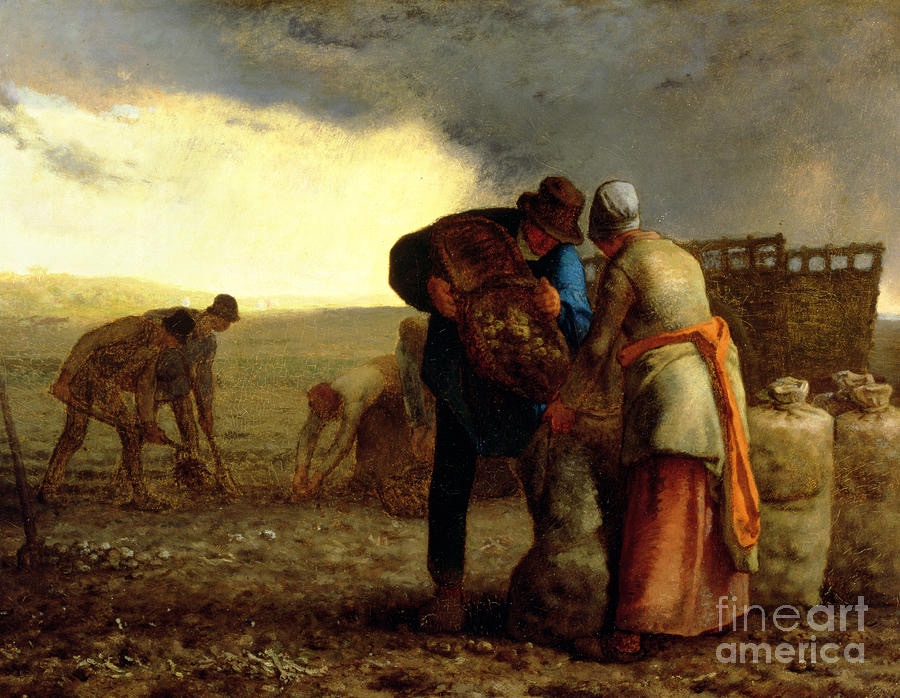
The Potato Harvest, Millet

A poem by Wendell Berry, “Whatever Is Forseen In Joy”:

Whatever is foreseen in joy
Must be lived out from day to day.
Vision held open in the dark
By our ten thousand days of work.
Harvest will fill the barn; for that
The hand must ache, the face must sweat.
And yet no leaf or grain is filled
By work of ours; the field is tilled
And left to grace. That we may reap,
Great work is done while we’re asleep.

When we work well, a Sabbath mood
Rests on our day, and finds it good.

Wendell Berry works his own plot of land in a community that has sustained his family and neighbors for generations. They know the weariness that comes from “ten thousand days of work” but are sustained by having the vision of a plentiful harvest that has been “forseen in joy.”

I have known farmers and their families and have come to appreciate the skill and tenacity they bring to their labors. After all their best efforts, they are always subject to unexpected events, severe weather, and price fluctuations.

            But most of the people I know are not farmers — we are people who have worked in education, health care, businesses and religious organizations.  For us, it can be hard to see or measure the harvest of our labors that we hope will “fill our barns.”

            Over the 30 years of being a parish pastor, I worked hard to develop healthy spiritual communities.  Of the 3 congregations I served, every one has declined in membership in recent years.  I sometimes have asked myself, “What was it all for?”

            I once attended a clergy retreat where the leader said he has found many pastors will privately acknowledge that they experience depression.  He felt it arose from the feeling that you have failed to achieve what you had envisioned when you started.  But, he said, clergy accomplish more good than they realize — the results are not easily measured, but are present in peoples’ lives.

            So I look back at the “fields” I have labored in and can see how many relationships were nurtured, how much hope, joy and mutual support was shared, and how much grace was experienced. The buildings may have emptied, but not the lives of those of the people who were part of it all.

And what of your work? Does it feel as if your “ten thousand days of work” filled the barn?

            And what of our personal lives — our families and relationships?  Lives we have been responsible for may or may not have met our expectations when we began parenting. We may have planted and watered as best we can, but we are not the ones who create the growth.

            My mother used to say, “I want to live until I’m a hundred and see how it all turns out.” But she died suddenly at age 75, and all our stories were still unfolding.  Thirty years later, they still are.  I would love to know what happens to our kids and grandkids in the years to come, but I know my time will be completed when their lives are still being made.

So “the field is tilled and left to grace.” All the people we love and care for are seeking to do their best in this life. We may not know what the ultimate harvest will be of our life’s work, but “when we work well, a Sabbath mood rests on our day, and finds it good.”

            May we be grateful for the opportunity to labor in the fields of our lives, as well as the grace that will outlive us.


What Jayber Crow Understood

            For the first 25 years of my life, the idea of becoming a pastor was inconceivable to me.  I had not been raised in a church and had no interest in organized religion.  But life has a way of surprising us, it seems, and here I am, 41 years after my ordination. 

            It’s hard to explain why I have found it so meaningful; I often feel like I have never really fit in.  But one day I picked up Jayber Crow, a novel by Wendell Berry.  Jayber is a seeker, a barber, a grave-digger, and a church custodian in the fictional town of Port William, Kentucky.  I came across this passage, where he is sitting at the rear of the sanctuary on a Sunday morning:

            The sermons mostly were preached on the same theme I had heard over and over… we must lay up treasures in heaven and not be lured and seduced by this world’s pretty and tasty things that do not last but are like the flower that is cut down. The preachers were always young students from the seminary who wore, you might say, the mantle of power but not the mantle of knowledge.  They wouldn’t stay long enough to know where they were, for one thing.  Some were wise and some were foolish, but none, so far as Port William knew, was ever old. They seemed to have come from some never Never-Never Land where the professionally devout were forever young. They were not going to school to learn where they were, let alone the pleasures and the pains of being there, or what ought to be said there. You couldn’t learn those things in a school.  They went to school, apparently, to learn to say over and over again, regardless of where they were, what had already been said too often. They learned to have a very high opinion of God and a very low opinion of His works — although they could tell you that this world had been made by God Himself.

            What they didn’t see was that it is beautiful, and that some of the greatest beauties are the briefest. They had imagined the church, which is an organization, but not the world which is an order and a mystery. To them the church did not exist in the world where people earn their living and have their being, but rather in the world where they fear death and Hell, which is not much of a world.  To them, the soul was something dark and musty, stuck away for later. In their brief passage through or over it, most of the young preachers knew Port William only as it theoretically was (“lost”) and as it theoretically might be (“saved”) and they wanted us all to do our part to spread this bad news to others who had not heard it — the Catholics, the Hindus, the Muslims, the Buddhists, and others — or else they (and maybe we) would go to Hell. I did not believe it. They made me see how cut off I was. Even when I was sitting in the church, I was a man outside.

            In Port William, more than any place I had ever been, this religion that scorned the beauty and goodness of this world was a puzzle to me. To begin with, I don’t think anybody believed it. I still don’t think so. Those world condemning sermons were preached to people who, on Sunday mornings, would be wearing their prettiest clothes. Even the old widows in their dark dresses would be pleasing to look at. By dressing up on the one day when most of them had leisure to do it, they signified their wish to present themselves to one another and to Heaven looking their best. The people who heard those sermons loved good crops, good gardens, good livestock and work animals and dogs; they loved flowers and the shade of trees, and laughter and music; most of them could make you a fair speech on the pleasures of a good drink of water or a patch of wild raspberries. While the wickedness of the flesh was preached from the pulpit, the young husbands and wives and the courting couple sat thigh to thigh, full of yearning and joy, and the old people thought of the beauty of the children. And when church was over they would go home to Heavenly dinners of fried chicken, it might be, and creamed new potatoes and creamed new peas and hot biscuits and butter and cherry pie and sweet milk and buttermilk. And their preacher and his family would always be invited to eat with somebody and they would always go, and the preacher, having just foresworn on behalf of everybody the joys of the flesh, would eat with unconsecrated relish.

            “I declare Miss Pauline,” said Brother Preston, who was having Sunday dinner with the Gibbses, “those certainly are good biscuits. I can’t remember how many I’ve eaten.”

            “Preacher,” said Uncle Stanley, “That’s making eight.” (160-161)

            …The people didn’t really want to be saints of self-deprivation and hatred of the world. They knew that sooner or later the world would deprive them of all it had given them, but they still liked it.  What they came together for was to acknowledge, just by coming, their losses and failures and sorrows, their need for comfort, their faith always needing to be greater, their wish (in spite of all words and acts to the contrary) to love one another and to forgive and be forgiven, their need for one another’s help and company and divine gifts, their hope and experience of love surpassing death, and their gratitude. (162-163)

            I thought of the people and congregations I’ve served.  Like Jayber, I never believed those kinds of sermons. I do believe in the “beauty and goodness of this world,” the sanctity of the ordinary people I’ve known, “cherry pie,” “good biscuits,” our “wish…to love one another and to forgive and be forgiven,” the “hope and experience of love surpassing death,” and gratitude.

            “…. for behold, the kingdom of God is in the midst of you.” (Luke 17:21, RSV)

Wendell Berry, age 88; Credit: New Yorker Magazine

Notes

  1. For a recent profile of Wendell Berry in the New Yorker, go to https://www.newyorker.com/magazine/2022/02/28/wendell-berrys-advice-for-a-cataclysmic-age
  2. I had the privilege of seeing Wendell Berry in person twice in my life. The first was in the 1980s at the Campbell Farm in Wapato, Washington, where he spoke on land stewardship and rural values. The second was at Campbell Hall at UCSB in the 90s, as part of an “Environmental Poets” series. A very shy man, he was wearing overalls and a John Deere hat that night – clothing one doesn’t often see in Santa Barbara. That night he read from Jayber Crow. In the Q and A, someone asked him if, given his lifelong advocacy for sustainable agriculture, he would endorse requiring a gardening class in high schools.  After a long pause, he said, “No, I think young people should be required to read Homer and the Bible, so they will know the problems they are facing are not new.” The “educated” crowd seemed bewildered by his statement.