You never know when something will happen that will change your life.
The Austrian writer Stefan Zweig was 32 years old on June 29, 1914, savoring the beginning of the summer season outside of Vienna:
I had rarely experienced one more luxuriant, more beautiful and, I am tempted to say, more summery. Throughout the days and nights the heavens were a silky blue, the air soft yet not sultry, the meadows fragrant and warm, the forests dark and profuse in their tender green; even today, when I use the word summer, I think involuntarily of those radiant July days which I spent in Baden near Vienna. In order that I might concentrate on my work I had retired for the month of July to this small romantic town where Beethoven loved to spend his summer holidays…
In light summer dress, gay and carefree, the crowds moved about to the music in the park. The day was mild; a cloudless sky lay over the broad chestnut trees; it was a day made to be happy. The vacation days would soon set in for the people and children, and on this holiday they anticipated the entire summer, with its fresh air, its lush green, and the forgetting of all daily cares. I was sitting at some distance from the crowd in the park, reading a book…Nevertheless, I was simultaneously aware of the wind in the trees, the chirping of the birds, and the music which was wafted toward me from the park. I heard the melodies distinctly without being disturbed by them, for our ear is so capable of adapting itself that a continuous din, or the noise of a street, or the rippling of a brook adjusts itself completely to our consciousness, and it is only an unexpected halt in the rhythm that startles us into listening.”
“And so it was that I suddenly stopped reading when the music broke off abruptly. I did not know what piece the band was playing. I noticed only that the music had broken off. Instinctively I looked up from my book. The crowd which strolled through the trees as a single, light, moving mass, also seemed to have undergone a change; it, too, had suddenly come to a halt. Something must have happened. I got up and saw that the musicians had left their pavilion. This too was strange, for the park concert usually lasted for an hour or more. What could have caused this brusque conclusion? Coming closer I noticed that the people had crowded excitedly around the bandstand because of an announcement which had evidently just been put up. It was, as I soon learned, the text of a telegram announcing that His Imperial Majesty, the successor to the crown, Franz Ferdinand, and his wife, who had gone to the maneuvers in Bosnia, had fallen victims of a political assassination there.”
Franz Ferdinand was not popular in Austria, “and so the news of his murder aroused no profound sympathy. Two hours later signs of genuine mourning were no longer to be seen. The throngs laughed and chattered and as the evening advanced music was resumed at public resorts.” – Stefan Zweig, The World of Yesterday
But the assassination set off a tragic chain reaction of events that led to the outbreak of World War on July 28. Four years later, 8 million people had died, 7 million people were permanently disabled, and 15 million were seriously injured. The immense suffering of World War 1 led to the rise of Nazism, the Soviet Union, and World War 2. Zweig, a beloved writer across Europe, eventually saw his books banned because he was Jewish. He eventually fled to Brazil where he finished The World of Yesterday in 1940. The next day, overcome with despair, he took his own life.
There are dates that change our lives. December 7, 1941, with the attack on Pearl Harbor. The attack on the World Trade Center on September 11, 2001. The Hamas attack on Israel October 7.
My friend Father Larry once said that every year we celebrate the date of our birth. We do not know what day on the calendar will be our last, but that day will surely come; until then we pass it by unaware.
One newsflash, one phone call, one text, and our life changes forever.
Such days are not all dark days. Some days we remember because they mark turning points that lead to joy: a day when we fell in love, a day when we got a letter or a phone call offering us a great opportunity in our education or work, a day when a child is born.
I will always remember an afternoon in the spring of 2006. I was rushing to perform a memorial service and was just pulling into a parking space when my cell phone rang. It was our oldest daughter calling from Seattle. I answered and, before she spoke, asked if I could call her back in an hour. “No, dad, I’ve got something to tell you.” She paused. “You are going to have a grandson.” I remember nothing about the service that day; I will always remember her words and that moment.
A major theme of the spiritual traditions is a plea to not take our days for granted — to be aware of the goodness that surrounds us every day. If I am not rushing off to do something in the early mornings, I take time to recall seven blessings I experienced the previous day. I remember the details of each one. I want to be aware of such things while I can.
Another major theme is caring for the world beyond ourselves – doing the things that make for peace. The world we’ve created is a fragile thing; we must handle it with care.
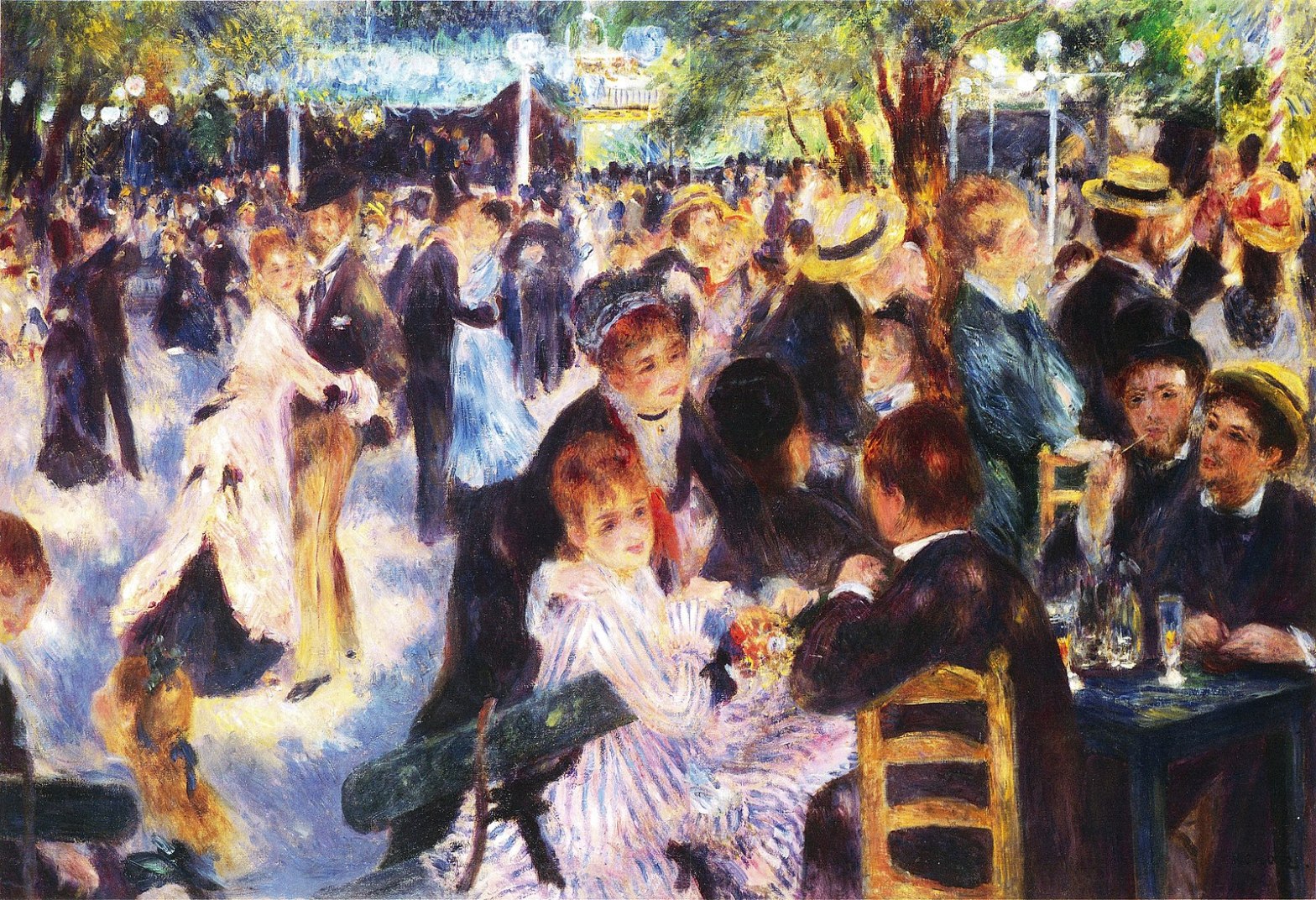
Painting: Dance at Le Moulin de la Galette, Auguste Renoir, 1876
 Steve Jacobsen, Ed.D