Turning Towards the Serene Light

         In my lifetime, I’ve explored many kinds of prayers, meditations, mantras, mindfulness techniques and awareness exercises.  I’ve used them to help me on my personal journey, to occupy myself at night when I can’t sleep, to center myself before walking into difficult situations, and to share them with others in classes and retreats. One ancient prayer I keep coming back to is the “Serene Light” prayer.  Some of you may already know it. I want to share it and include some personal comments.

         This prayer arose in the Eastern Orthodox tradition centuries ago. In the simplest sense, it uses light as a metaphor of the divine presence – light in darkness being one of the most common metaphors in global spiritual traditions.  It’s not dependent on you believing any specific religious doctrines, but only on a simple desire for a spiritual connection.

         Like many prayers, its effectiveness depends on our intention — the way in which we recite it.

A writing teacher once said that the difference between prose and poetry is that good prose keeps you moving from one idea to the next, speeding up as you go along.  Good poetry – and prayers — are different.  They invite you to slow down, pause and think about what each phrase means, letting it linger and speak. It’s like putting flower petals on water one by one and watching each one float before you add the next one. Or sipping a good glass of wine instead of gulping it down.  The “savoring” approach lets each image or thought take shape and sink in; our sense of time slows down, which eases us into a more reflective state of awareness.

So, here’s the prayer, followed by some of my comments on each phrase:

Serene light,

shining in the ground of my being,

draw me to yourself.

Draw me past the snares of the senses,

out of the mazes of the mind.

Free me from symbols, from words,

that I may discover the signified,

the word unspoken,

in the darkness,

which veils the ground of my being

  • “Serene light” – the light I seek is not glaring or flashing, but calm and quiet. It radiates peace and strength. It is unaffected by my fears and anxiety. In the mystical traditions this light is at the heart of all creation. 
  • “shining in the ground of my being” – In one way, this light is beyond the busy-me that chatters all day. But in another way, it lies deep within me, at my center.  It shines, and in so doing offers me a focus, a goal, and a presence.  I imagine it shining within me.  
  • “Draw me to yourself” – Like a thirsty animal seeking water during a drought, I affirm my desire to come closer to this light.  I am not asking to abandon my own sense of self or avoid my responsibilities. But I want some help, some aid, some infusion of peace as I face what is before me. I trust the light will help me.
  • “Draw me past the snares of the senses” – We are wired to have our attention react quickly to many kinds of stimuli.  If I see something move, my eyes immediately evaluate what it is. If I hear a sound, my brain is compelled to analyze the source.  The same is true of all my senses. I can spend every minute of the day being subject to these distractions, becoming “ensnared” in the constant flow of information. But in this moment, I want to slow down, reduce the mental static, and not give in to distractions. I am choosing instead to seek the light.
  • “…Out of the mazes of my mind.” Just as my senses can keep me constantly distracted, so my mind is in the habit of jumping from one thought to the next, creating strategies and scripts to protect or promote myself.  But right now, I want to ascend above the clouds to see a greater horizon; I want to rise above the “mazes”.
  • “Free me from symbols, from words…”  Most moments of awareness are dependent on ordinary things and familiar concepts, but we can reach beyond them. In this prayer, I am using symbols and words like “light” and “mazes”, but those are not my goal. Beyond my cluttered, ordinary thinking is something greater I can sense when I am still.
  • …that I may discover the signified, the Word unspoken.”  There are endless names for the divine; Islam alone offers 99. Each word suggests a specific spiritual experience and relationship, but all are limited to a specific aspect of our understanding.  In saying this prayer, I want to go beyond all language and move closer to the “serene light.”   Ultimately, I seek the source of the light, which I cannot fully know. But I don’t need to “know” it in an ordinary sense — I only need to draw close to it.
  • “…in the darkness which veils the ground of my being.” The darkness is not a forbidding or dangerous darkness — it’s “dark” because I can’t ever “see” the “ground of my being” as I can an everyday object.  It’s the mysterious dimension in which our souls exist.

It’s ideal to memorize the prayer so it’s available whenever we want it.  And it’s important to know that we don’t have to look for immediate results to experience its power.  Sometimes it’s enough to have taken the time to live within the prayer for a set time, and the effects may be experienced later in the day.  If you do have specific concerns on your mind, you can add those requests after you’ve taken the time to dwell in the prayer; coming from a more peaceful inner space helps us focus what it is we seek.

The “Serene Light” prayer is a gem that I’ve turned to again and again and have always been grateful for where it leads me.  Perhaps it can also be useful to you.

Image: Spika Star, New Forest Observatory
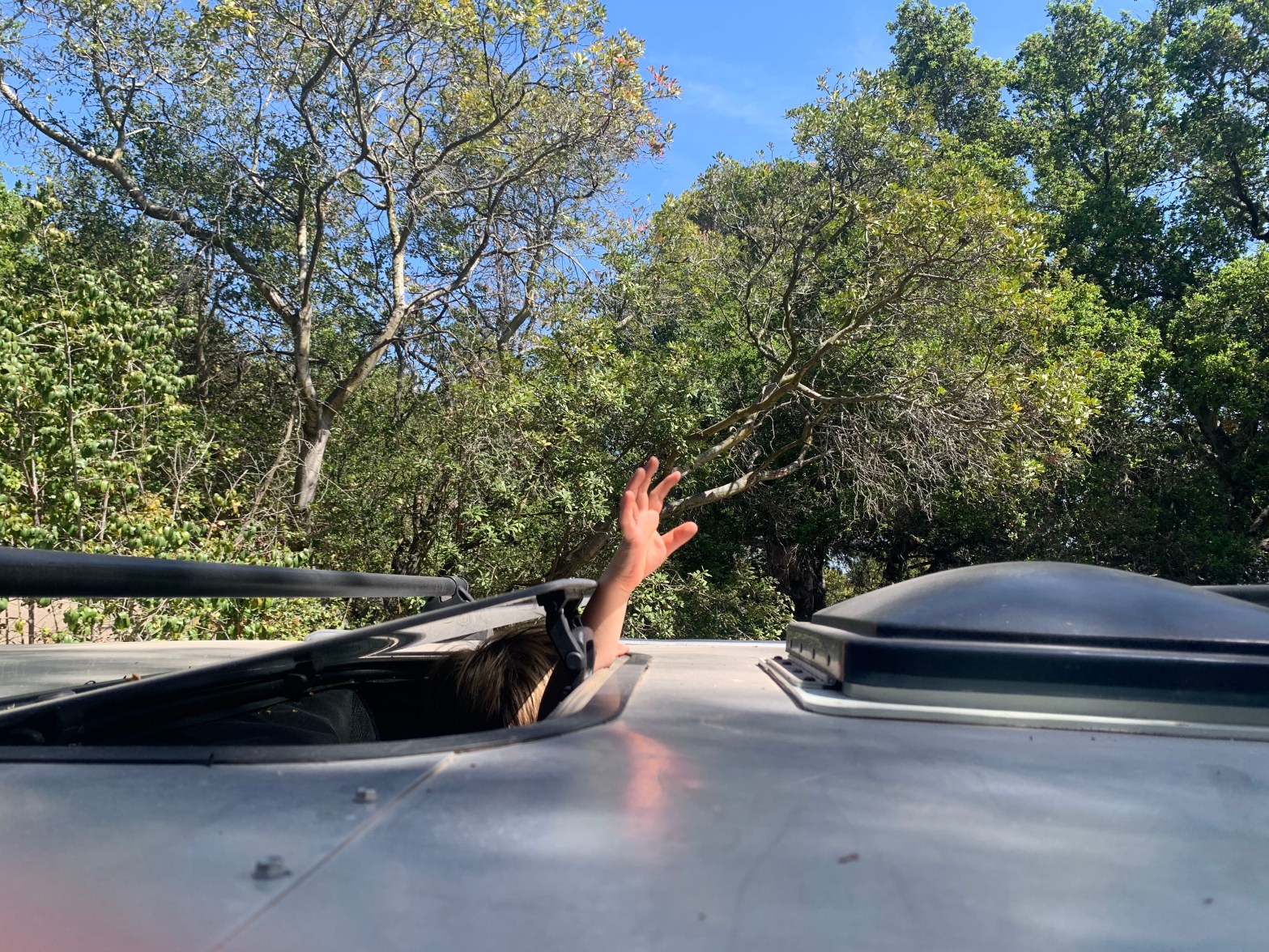
Time to Go Vertical?

Today’s piece begins with a quiz. This photograph is:

  1. My grandson reaching out of our trailer’s skylight to see what it feels like.
  2. A visual metaphor for prayer.
  3. All the above.

            If you answered “c” you are correct.

            Last week’s entry on enlightenment included an homage to Huston Smith. No writer or thinker has inspired me more.  He consistently drew on a lifetime of scholarship and personal experience to make memorable, useful and simple statements.  The statement for today is: “When you find yourself in a difficult place, go vertical.”

            Huston believed that spiritual traditions are based on higher truths.  We live much of our lives “horizontally” – going through the day with routines, assumptions and interactions that serve us well.  But sometimes we run into situations – tragedies, difficult decisions, illnesses, crises — when ordinary ways of thinking don’t help. In those moments we can turn to spiritual truths, passed on to us from people who have transcended ordinary reality to see the bigger picture.  That’s going “vertical.”

            I’m going to share some experiences of “going vertical,” but first I will address concerns thoughtful people may have about “going vertical.” 

            “’Isn’t this an outmoded way of thinking with the divine being “up there” and us “down here?’” It’s a reasonable question.  Many ancient people did believe the divine was too pure or holy to be down in the muck with us.  God must be up at the top of that mountain, far away and safely removed.  Most of us would agree that’s not the way we think anymore.

             If someone asks me, “Where is God?” I would say “everywhere.”  Within each cell of every living creature, as well as all creation, as well as far beyond what we can see or know.  As Psalm 139 puts it:

Where can I go from your spirit?
    Or where can I flee from your presence?
If I ascend to heaven, you are there;
    if I make my bed in Sheol, you are there.
If I take the wings of the morning
    and settle at the farthest limits of the sea,
10 even there your hand shall lead me,
    and your right hand shall hold me fast.
11 If I say, “Surely the darkness shall cover me,
    and the light around me become night,”
12 even the darkness is not dark to you;
    the night is as bright as the day,
    for darkness is as light to you.
(New Revised Standard Version)

            Jesus taught that the kingdom of God is not far away, but within us and amongst us.  People experienced his stunning presence right where they lived – they did not have to ascend a mountain.  Buddha was asked where the authority for his teaching came from; he touched the ground and said, “Let the earth be my witness.”  Muhammed taught that Allah is closer to us than our own jugular vein.

            So, we don’t have to go up a mountain to find the divine.    

            But I believe it’s still useful to use metaphors that suggest we “go up” for spiritual truth.

            When your airplane lifts off and you see your town from a higher altitude, you can see where you live with greater perspective.

             “Inspiration Point “is a favorite hiking destination in Santa Barbara.   When you get to the top you have a stunning vista over the town and coastline. It’s in-spir-ing, as in “in-Spirit-ing.”

            So, it’s useful to consider spiritual truths as “Higher” because when we grasp them, many other things come into perspective.

            The trajectory of my life was changed in my early 20s when I was in a personal crisis. I’d been self-absorbed, skeptical of any truth beyond my own reasoning.  But at a moment when I felt my life was going to pieces, I reached out into the unknown and “went vertical:” I prayed for the first time. I’m not even sure what I said. But metaphorically my hand was reaching out into the unknown hoping something “up there” or “out there” might help me.  Three days later, I realized something had changed – at my very center, instead of darkness and fear, there seemed to be a tangible point of light.  I was stunned. I was grateful. It took me a long time to integrate the experience, but my life was literally saved when I “went vertical.”  It was my first experience of grace.

            Ministry is all about helping people “go vertical.”  

            For example, people would make an appointment with me and say, “I think my wife is having an affair with someone at work and I’m worried our marriage may be in danger.”

            I would ask for more background. If appropriate, I would say:

            “One of the most important things you can do is to deepen your spiritual life. This will make you stronger for whatever happens.  If reconciliation is possible, you will have a better sense of who you are and how to repair the relationship.  And if your partner does leave, faith will be a lifeline to take with you into the unknown.”

            In January of 2020, I flew to Vienna on my own for two weeks.  For the first several nights, jet lag kept me awake for hours.  I “went vertical,” spending much of the time reciting the 23rd Psalm in a careful, contemplative way.  I not only got through the night but sensed a kinship with all the people I know who live alone.

            When COVID came, prayer and meditation became even more important.  The divine presence is not threatened by a virus.  I am grateful for the daily renewal I felt in those early months, “going vertical” instead of being shut in by fear.

            There are many issues to explore regarding how we pray and what to expect. But I never regret a moment when I find myself afraid or uncertain and “go vertical,” reaching out for what I cannot see.

            Have you had such experiences?

            “The winds of grace are always blowing, but it is you who must raise the sails.” (Tagore)