Is there an invisible “place” within you in which feelings and thoughts appear that seem different from your everyday thoughts? Something like a “still, small voice” that surprises you at important moments, offering insight, encouragement, or maybe an invitation to do something new?
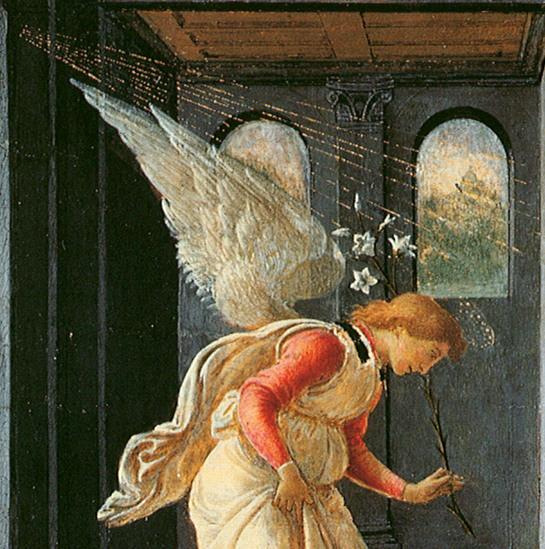
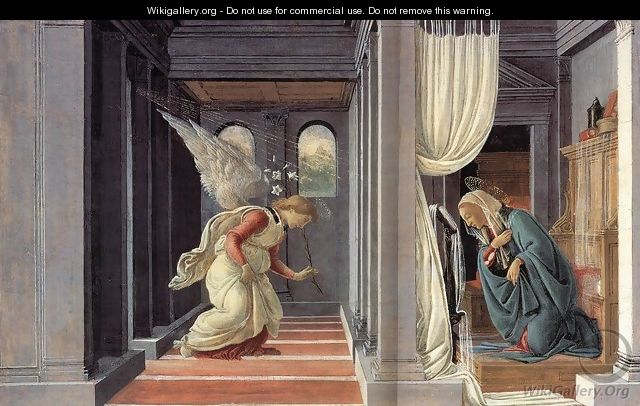
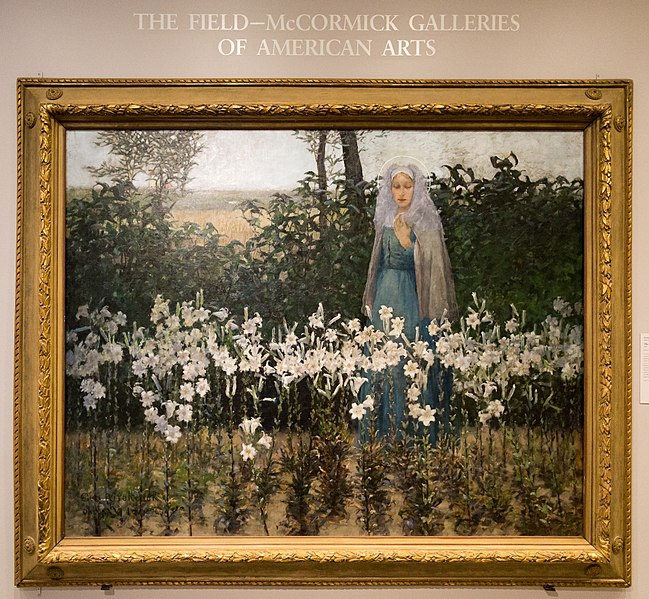
I am going to explore this “place” by focusing on a figure whose story is very much a part of the Christmas season: Mary, the mother of Jesus. I’ll share reflections from my journey, a famous passage from Thomas Merton, and six paintings spanning seven centuries which illustrate ways the story has been imagined visually.
Growing up we had a small plaster nativity set that we unpacked this time of year. The Mary figurine was painted blue and white; she was kneeling and had acquired a few chips. But she had no personal meaning for me.
In my mid-twenties, my spiritual journey had begun, and I spent three years earning a Master of Divinity degree at Princeton Theological Seminary. You’d think if you became a “Master of Divinity” you would learn all the important things. But that wasn’t the case.
After graduation, I became interested in “the inner life”. I discovered the work of the psychologist Carl Jung and gained an appreciation for truths that come through dreams, visions, myths, and imagination. Biblical stories became richer. I began practicing meditation, times of silence, and journaling. I went on retreats at monasteries and became curious about the Catholic tradition.
A new world was opening, and the figure of Mary emerged. Most of the debates about her had focused on being the “virgin” mother of Jesus. What fascinated me had nothing to do with sex, biology, miracles, or doctrines, but something else – how Mary can be a rich metaphor for spiritual experience.
As the story goes, the angel Gabriel appears unexpectedly one day, telling her she is favored by God and chosen to bear Jesus. She is afraid and questions how this could happen. Gabriel assures her anything is possible for God. She ponders her choices. She decides to accept a role she did not seek or imagine, one that will create many challenges for her. “Let it be to me…” she says. The angel disappears. Her life unfolds.
I know people of good faith who believe the story is completely factual, and others who do not. My practice over the years is to honor both perspectives and look for the soul meaning of the story, which is more like interpreting a vivid dream than performing scientific or historical research. I often think of a quote attributed to Black Elk: “This they tell, and whether it happened so or not I do not know, but if you think about it, you can see that it is true.”
So what’s the “soul meaning” of Mary’s story?
Imagine this: a thought appears within us that has a different quality than our everyday thoughts. It can feel like a message sent specifically to us. We consider it. We know we are free to ignore it. But we decide to trust it and change direction in our life. The change may not make life easier – in fact it may mean taking on challenges and responsibilities we had not sought before. But as time goes on, we are grateful for the change we made. We remember the moment we received the message and realize it came with love and wisdom. We feel awe, and we feel gratitude
Thomas Merton was one of the great spiritual writers of our time. At one point in his life, he had a profound revelation: Mary’s story is ultimately about how the divine can be born in everyone. All of us, Merton saw, have within us a pointe vierge, a virgin point:
“At the center of our being is a point of nothingness
which is untouched by sin and by illusion,
a point of pure truth,
a point or spark which belongs entirely to God,
which is never at our disposal,
from which God disposes of our lives,
which is inaccessible to the fantasies of our own mind
or the brutalities of our own will.
This little point of nothingness and of absolute poverty
is the pure glory of God in us …
It is like a pure diamond, blazing with the invisible light of heaven.
It is in everybody,
and if we could see it
we would see these billions of points of light
coming together in the face and blaze of a sun
that would make all the darkness and cruelty of life vanish completely …
I have no program for this seeing.
It is only given.
But the gate of heaven is every- where.”[i]
I’ve had experiences that lead me to believe Merton is right. There is something deep within us that is “pure,” an opening to another reality that is “inaccessible to the fantasies of our own mind or the brutalities of our own will.”
I’ve had promptings that didn’t seem to come from the same inner source that talks to me all day long. These promptings always surprise me. They’ve offered me new possibilities I had not imagined or wanted; over time I find I’m being led into a deeper experience of life and service.
I’ve witnessed such experiences in the lives of many parishioners over the years who, after long periods of struggle and uncertainty, find a peace, calling or insight that surpasses their understanding.
In hospice work, I’ve seen people discover unexpected clarity about life that has nothing to do with what they are supposed to believe, but is fresh and authentic.
Working at the La Casa de Maria Retreat Center (“The House of Mary”), I saw people of many backgrounds find healing, hope, and courage when they left distractions behind and settled into a calmer, more receptive and reverent state of awareness. The new directions did not come from personal fantasies or restless will, but something deeper, an inner light that is subtle and wondrous and real.
We can’t control or predict when such points of light appear. As Merton says, “I have no program for this seeing. It is only given. But the gate of heaven is every- where.”
Hail, Mary, full of grace.
[i] Thomas Merton, Conjectures of a Guilty Bystander
Imagining The Annunciation: A Sampling from Art History



 Steve Jacobsen, Ed.D