A Gift To Give the People You Love

There’s a precious gift for your loved ones that’s easy to give and doesn’t cost a nickel.

            I’ll start with two personal stories.

            We always thought my dad would die before my mom, as he had ongoing health issues. But on a Saturday morning in 1993, my mom had a massive cerebral hemorrhage. She lingered for ten days, and, as far as we could tell, may not have been able to understand anything we were saying to her.  Suddenly she was gone.   We were left with the decision many families face: what do we do for a memorial service?  Luckily, we all remembered something she said many times: “When I die, I want to go out to ‘When The Saints Go Marching In.'”

            We focused on creating a service that would honor mom’s spirit.  We were all willing to speak and, working with the pastor, chose some hymns and readings. We gladly accepted an offer from a family friend to play a medley of Gershwin songs that mom loved.  But the most important act was to honor her request for “All the Saints.” 

            The church organist found a trumpeter in town who could play “When the Saints” Dixieland style.  The pastor gave the closing blessing. From the back of the church the trumpeter began playing very quietly and slowly as Dixieland musicians do. Then he picked up the tempo.  The organist joined in.  Soon the sanctuary was rocking.  We walked down the aisle with smiles and tears.  This is what mom wanted.

            Mom told us one thing she wanted to have at her memorial service.  That one thing was an anchor in a confusing time.  It didn’t take away our shock or grief. But the memory of it still brings us joy.

            Here’s the second story.

            When I was a pastor in Goleta, a woman named Lela came to my office.  She wanted to transfer her membership to my congregation and have me lead her memorial service.  Two years later, she died of cancer.  When I met with her family, they gave me a complete script Lela had created. She’d been a musician herself and knew exactly what she wanted at each point in the service, including readings and specific recordings of favorite classical pieces.  Knowing “this is what Lela wanted” allowed us to honor her wishes to the letter. 

            In my 40 years as a pastor, I’ve been involved in a great variety of memorial services. Some were in overflowing sanctuaries. Some were with two or three people at a graveside.  Every time, I did my best to create an experience reflecting the unique spirit and life of that person.  The variety is endless:

  • In my rural parish, I did a service for a ranch hand that ended with his favorite song, “Streets of Laredo.”
  • Several services ended with a bagpiper playing “Amazing Grace” and escorting us out – there’s something about those “pipes” that stirs the soul.
  • I led a service for a much-loved Hispanic man in Santa Paula who had been a Korean War vet.  When we got to the cemetery, a military honor guard carried his casket to the gravesite – followed by a mariachi band.
  • I attended a service at the Santa Barbara Mission for Richard Aberle, a long-time Hospice board member. Richard loved life and music and had specified what he wanted in his service.  As I walked into the sanctuary, instead of hearing a dreary organ, a string ensemble was in the balcony playing “The Blue Danube Waltz” by Strauss.  It was joyous, life-affirming music that expressed the way Richard lived his life.

            The common thread in these services was following the wishes of the person who had died in a way that expressed their unique character and spirit.

            Have you told anyone what you would want?          

            I’m just now updating notes for my service.  It includes readings (the 23rd Psalm, King James version), favorite hymns, Joe Cocker singing “A Little Help From My Friends” at Woodstock (a favorite memory from my youth) and the final scene in “The Natural,” when the aging Roy Hobbs (Robert Redford) hits his last home run and knocks out the lights.

            My dear friend Father Larry once said there’s a date on the calendar that will be the date of our death. Every year we pass that day not realizing the significance it will have.  We don’t know the day, but we do know there are simple things we can do to support those who will be faced with the task of honoring us with a service when that day comes.

            It can be as simple as telling someone one or two things you would like.  Do that today or in the next few days, in person or in writing.  My mom had one wish, and we are forever grateful we knew what it was.

            Or you can take some time and make a list of suggestions, like Lela did. Below is the checklist I’m using this week to update my plans.  When I complete it, I’ll put a copy where we keep other important documents.

            I’ve been doing memorial services for more than 40 years – I guarantee you anything that you do will be a gift to those you love.

            I encourage you to do it now.

Steve

————————————————————————————-

Suggestions for My Memorial Service

            Dear Family: These are suggestions for my service…use them if they seem fitting and practical at the time:

  1. The place:
  • Readings:
  • Music:
  • Speakers:
  • Images/video clips:
  • Food at the reception:
  • Where my body can be buried/ashes scattered:

Still Life with Twelve Sunflowers, Van Gogh
“Is Life All About How We ‘Finish?’”

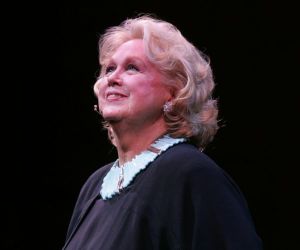
            On January 20, 2006, at age 78, she made history by being the first popular singer to have a solo concert at the Metropolitan Opera in New York.  She was a sensation on Broadway when she was younger, winning many awards including an Emmy for her role in the original The Music Man.  She had the voice, looks, and acting skill of a star.  But after years of success, her career faded.  She withdrew from public performances as she struggled with alcohol, obesity, and depression.  In time, a close friend and collaborator convinced her she still had a great gift to share with audiences. She began performing in public again, which led to that night at the Met.

            When Barbara Cook walked on stage that night, she got a standing ovation.

            The second song she sang was particularly poignant given what she’d been through. It was from a 1973 Broadway musical, “Seesaw:”

            It’s not where you start, it’s where you finish.

            It’s not how you go, it’s how you land.

            A hundred to one shot, they call him a  klutz

            Can out-run the favorite, all he needs is the guts.

            Your final return will not diminish

            And you can be the cream of the crop;

            It’s not where you start, it’s where you finish,

            And you’re gonna finish on top.

            After reading a rave review of the concert album, I bought a copy and have grown to love this song.  It has that spunky, sassy, celebratory spirit of so many Broadway songs, and she is amazing.  “It’s Not Where You Start” begins playing in my head some days, and the spirit of it makes me smile and swagger.

            Barbara Cook died in 2017, beloved by her colleagues and fans not only for her many gifts but also for her comeback.  If life’s about “how you finish,” she finished her life “on top.”

            But I’ve been reflecting on the theme of the song.  I find myself thinking of all the people I’ve known over the years in my personal life, ministry, and hospice work, and ask myself:  Is it always true?  Is “where you finish” the most important measure of your life?

            Bob was a member of the first congregation I served in Santa Paula.  He was a big guy and full of life.  He was a proud Marine who had been in some of the most intense battles in the Pacific and achieved the rank of captain.  He’d then made a career in the fruit packing business and raised six children with his wife Jean.  We rented a house just one door away from Bob and Jean, and grew to be close friends, often sharing wine, crackers and cheese on our front porches and vacationing together.  He took delight in needling me. Sometimes when I’d call young people to come forward for a children’s sermon, he’d walk up with them and sit on the steps, staring at me with a deadpan gaze. After retirement he became a Hospice volunteer and told me it was the most meaningful thing he’d ever done.  I loved the man.

            After we left Santa Paula for Washington state in 1985, we stayed close.  Moving back to Santa Barbara in 1992 meant we were only an hour away from Santa Paula, which enabled us to spend time together once again.

            Bob became ill in 2005. In his last months he was in a nursing home with dementia.  The dementia released some of the long-suppressed traumatic memories of the war, and Bob’s anger and confusion was a serious challenge for staff and guests. He died early in 2006.

            I think of the life of my dear friend Bob, and ask: Is it always about how we “finish”?

            My answer: No.  Bob’s life was full of hard work, responsibilities, sacrifice, service, joy, and love.  What he went through in the last few months does not define him or take away all he did.

            I can think of many people I’ve known who have died in nursing homes and car accidents, from heart attacks and strokes.  They did not have a chance to complete their journey as they would have liked. But their end doesn’t define their life.

            We long for perfect, inspiring endings in movies, television series, musical pieces, novels, careers, and personal stories. But real life doesn’t always supply them.

            I am going to keep on listening to Barbara Cook sing “It’s not how you start, it’s how you finish.”  I will always be inspired by her story and legacy. I am also continually inspired by the life of my friend Bob.

            I want to live with “guts” and “grit.” Yet I know I cannot be guaranteed an ideal conclusion to my life. What I do know is that I can trust the grace of God, which is far greater than my expectations.

Steve

Barbara Cook singing “It’s Not Where You Start”  in Melbourne.  The picture quality is grainy, but her spirit shines:

The Art of “Living in the Tragic Gap”

         There are two stages of life: the first is when we are aspiring to perfection, the second is when that is no longer viable, and we begin to look within.  — David Brooks

         Commencement speakers often encourage young people to dream big.  I don’t remember who spoke when I graduated from UCSB years ago, but I had big dreams.  My plan was to work six months and save enough money to travel in Europe, where I had a connection for a job.  After a year I’d come back and begin law school.  By age 40 I was going to be a millionaire — then retire and travel more.

         I knew it was possible.  I’d heard stories about people who had done things like that.  If it happens for some people, why not me?

         It didn’t work out that way.

         It took me a year to earn the money I needed. My time in Europe was cut short when I was denied a work permit.  I completed one year of law school and then withdrew, got married and became a father.

         I thought marriage and parenting would be easy.

         It didn’t work out that way.

         Marriage, it turns out, is a lot of work.  Parenting as well.  “Perfection” turned out to be elusive.

         By my late 30s I was depressed. My net worth was zero and my professional path seemed empty. I had friends who seemed to be thriving, which made it worse. I’d been living with unrealistic expectations and was now painfully coming to terms with the harsh facts of life.        

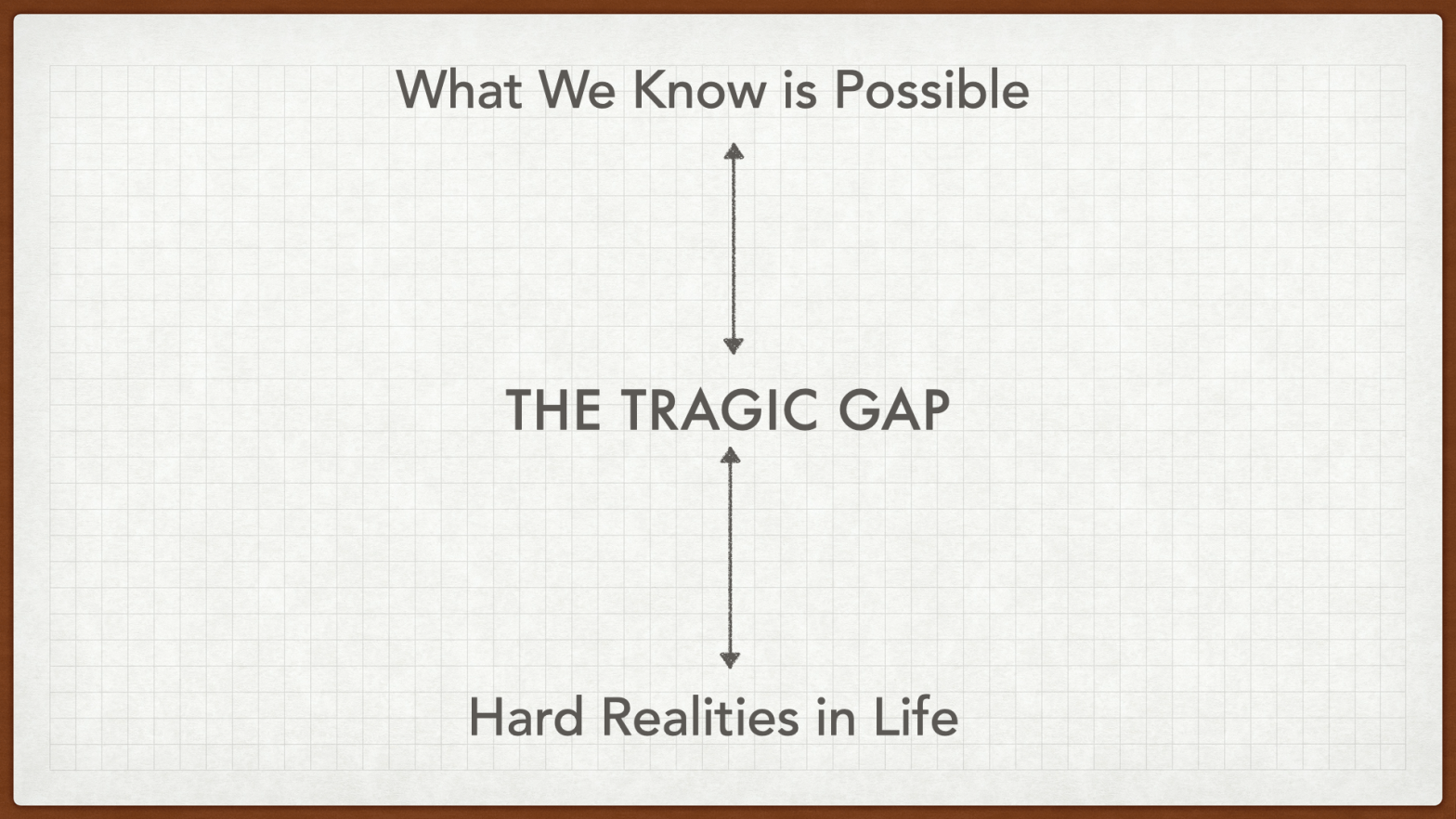
This polarity is something the writer Parker Palmer knows well.  Having gone through his own journey, he learned how to live with the tension between high hopes and hard realities.  It’s a life skill he calls, “Living in the Tragic Gap.” Here’s how it works.

       Many of us start out with lofty hopes and naïve expectations, but eventually encounter disappointments and dead ends. 

         When this happens, we can be faced with two temptations.

         One temptation is to keep chasing those hopes at all costs.

         “Look at that guy making a lot of money – he seems happy. I am going to keep pushing to succeed, no matter the cost.”

         “I deserve to be happy and satisfied every day.  If I’m not, it’s clearly somebody else’s fault, not mine.”

         “As a parent, I’m going to read all the books and do the right things. If I do that, my kids – and I – will live a worry-free life.”

         “Aging will never happen to me. I’ll find a program, a surgery, a diet or a guru that will keep me looking and feeling young.”

         We can become completely absorbed by unrealistic ideals of how life “should” be. Parker Palmer calls this, “irrelevant idealism.”

         The second temptation goes to the other extreme. 

         When the realities of work, marriage, and family life fall short of what we thought we deserved, we can become bitter. We lash out at other people, society, God or ourselves.  Or we feel broken and ashamed and withdraw into depression and resentment.  This is the temptation Palmer calls “corrosive cynicism.”

         But there is a third path, one that avoids the two temptations: “Living in the Tragic Gap.” The “gap” can feel “tragic,” as we must accept the fact our ideals may be impossible to fully realize.  But accepting the gap and negotiating life within it is the beginning of wisdom.  We don’t give up hopes and ideals but begin to balance them in the context of life’s realities.  As David Brooks said, once we are done “aspiring for perfection,” we “begin to look within.”

         Little is really known of Jesus’ life before he was 30.  But it was probably after a long period of looking within that he emerged with his compelling vision of the kingdom of God.  He encountered ordinary people struggling with life. Through him they experienced a new, grace-based way of seeing themselves and the world. This was not an escape from the realities of life but instead gave clarity and meaning to life as it is.

         The classic story of Buddha’s life is similar.  He was rich and healthy. He was carefully protected from suffering, living the first part of his life in the equivalent of a privileged, gated community. But he sensed something was missing.  He went out to see the real world and found the harsh realities of sickness, aging, and death.  But he kept pressing for a realistic way to make sense of it all.  In time, he experienced enlightenment and passed his insights on to countless others; “problems” will never stop arising in life, but we can develop an awareness that keeps us from being absorbed by them and instead find a boundless source of compassion within.

         In my work, I’ve met many people who became aware that perfection was no longer an option and were hungry for an alternative. I met them in my role as a pastor over the years. I met many when I was Director at La Casa de Maria Retreat Center. People were looking for something more, some way to stand between high hopes and hard realities. And when they’d find their footing, it was as if real life began.  They became humble, but also caring.  They took responsibility for their life choices and learned from their losses.  They found a certain kind of quiet courage to go on.

         Hospice of Santa Barbara has a long history of supporting people of all ages in the grief process.  When I was serving there, I was particularly struck by the work with children and teenagers who’d lost a parent.  One group support session ended with a time for the participants to create a work of art that expressed how they felt and what they’d learned.  A 15-year-old boy painted a picture of a heart broken open with blotches of red coming out of the broken space, growing larger as they emerged.  He wrote: “Death is like a broken heart.  It hurts and is sad, but you get through it.  Your heart is twice as strong.”

“Six Things That Matter Most” — A List for All Seasons

            There often comes a time when a family is told their loved one has just a few hours or days left before dying.  It can be an agonizing time of not knowing what to do other than wait.   The loved one may still be able to communicate or, more often, is sleeping much of time.  What do you do when “there’s nothing more to be done”?

            Ira Byock, a leading physician in contemporary hospice and palliative medicine, came up with a helpful resource for such times.  He would take his prescription notepad and write four phrases: “Please forgive me. I forgive you. I love you. Thank you.” He would give that to a family member and invite them to consider if any of those statements would be appropriate to say.  He wrote an influential book on the transformative and healing experiences he witnessed arising from people using these simple statements.  As the book became popular, two more were added: “Goodbye” and “I am proud of you.”

            The values represented in these statements — forgiveness, love, gratitude, and acknowledging the cycles of life — are universally present in the great spiritual traditions.

            When I was at Hospice of Santa Barbara, we took those six statements and had them printed on business cards.  Our staff and volunteers could then give them to families when appropriate.  I began to carry some in my wallet, a practice I’ve continued for more than a decade.

            I was grateful to have the card when my father was dying.

            He was in his last days at a nursing home. My two sisters and I used the list as a prompt for talking to him. He was no longer responsive, but it felt like the right thing to do. Maybe he heard us or maybe not.  Maybe he could sense what we meant through tone or feeling. Or maybe it was just for us.  

            “Dad, please forgive me for the sleepless nights I gave you as a teenager.”

            “There were times when I was growing up I was afraid of your anger.  I knew you were under a lot of pressure and loved us, but it was still scary. I forgive you.”

            “Thank you for providing for us, encouraging us and believing in us.”

            “For the way you worked so hard to honor mom and provide for us, for the integrity and honesty with which you lived your life, and for your service to our country during the war – we are proud of you.” 

            Dad wasn’t from a generation when many men would say “I love you.”  But we knew he loved us.  It was easy to say, “I love you, Dad.”

            The “Goodbye” statement can be tricky.  It can be tempting to say it to have some closure, but it may be too early.  (I remember one family had asked a harpist to play in the room; the patient woke up and said, “Get that music out of here…I’m not ready for the angels yet!”) But if, say, a family member is leaving town or death is clearly imminent, then “Goodbye” can be fitting.

            As I did presentations on hospice in the community, I would pass these cards out.  People would later tell me how helpful they were.

            But I also knew what everyone who works in hospice knows…the work is not just about the dying, but also about the living.  Whether dad was fully aware of what we were saying, it gave us closure. 

            The list can also be helpful after a death when we didn’t have an opportunity to speak the words in person. We can write a letter to the person using the list as possible prompts.  We can then save the letter just for ourselves. Or we can take it to a place we associate with the person, including a gravesite, and read it.  When it’s served its purpose, we can keep it or create a simple ritual and burn it.

            “Six Things” can also be valuable when death is not on the horizon. Roughly half of Americans die with some form of hospice care, which means there may be time for meaningful bedside moments.  It also means the other half of us will die without such an opportunity – heart attacks, strokes, accidents, etc.  If these are the six things that matter most, why wait for a moment that we may never have?  Why not use them when we are alive and well?

            Once, I was doing a daylong retreat on this theme. I gave the background and handed out the cards. Then I said, “But let’s not wait. I encourage us all to think if there is anyone we want to say any of these statements to now.”  I gave everyone 45 minutes. I’d brought stationery and envelopes if people wanted to write letters, and also encouraged people to make a phone call, send an email or text a message.  

            When we regathered, I asked for people to share experiences. One woman said she had called her daughter.  The call went to voicemail and mom left a message, “I just want to say I love you!” The daughter called back a few minutes later sounding frantic: “What’s wrong mom?! Are you OK??”  Mom laughed and reassured her she was fine, but was doing this as part of a retreat.  So, giving a little background can help when we are conveying such deep feelings.

            As time went on, I’ve found the “Six Things” a good way to take inventory from time to time in my own life on occasions like anniversaries and birthdays. Is there someone I want to say these words to now, since there’s no guarantee I’ll have a chance in the future?  Why not just do it? Once we do, there is a sense of freedom.

            Six simple statements, loaded with healing power. 

When Compassion Isn’t Enough

As part of my work at Hospice of Santa Barbara, a group of us attended a week-long retreat at the Metta Institute in Marin County. The theme was “Cultivating Presence” and led by Frank Ostateski, an accomplished teacher of both Zen meditation and hospice care.

            In one of his talks, Frank focused on the traditional greeting in parts of Asia – “Namaste.”  You clasp your hands palm-to-palm in front of your chin and sometimes follow with a slight bow.  It had become well-known in the West through its frequent use as a way to close a yoga class and was often said to symbolize “I bow to the sacred in you.”  Frank had closed his classes with the familiar gesture, and as students we returned the blessing.

At one session, Frank focused on a deeper meaning “Namaste” can have. One hand can represent the virtue of compassion and the other hand wisdom. He went on to describe the importance of the two virtues always being combined. We may feel great compassion for someone and feel the impulse to take an action. However, actions arising from a genuine motive may have unintended consequences. Therefore, it is critical to evaluate the compassionate urge with patient and practical wisdom if we want to make the best choices.

            I thought this was very helpful and began to share this concept when I was doing the initial training session for hospice volunteers.  Many are led into hospice service out of a compassion for those who are dying, but it is critical we always seek to place that emotion in the presence of wisdom from trained staff and veteran volunteers.  I often used the following story as an illustration. 

            Once we had a very caring volunteer assigned to a low-income family where the father had died.  The volunteer had spent time with the young son in the afternoon and when he dropped the boy off back at home, realized the family had very little food. Moved by compassion and wanting to make a difference, he and a friend went to Costco and bought several hundred dollars’ worth of food for the family and dropped it off at the house.  Soon after, one of the family members called our staff member responsible for the case. They noted how appreciative they were but said they did not have sufficient refrigerated storage to keep so much food and were embarrassed it would be going to waste.  If the volunteer had run his idea by our trained staff member, he would have been affirmed for the impulse, but guided into an action that would better fit the situation.  The compassionate value needed to be matched by wisdom.

            I was reminded of the charge Jesus gives his disciples when he sends them out in pairs for the first time: “… so be wise as serpents and innocent as doves.” (Matthew 10:16).   The serpent was seen a very subtle and clever creature (it was not always identified as evil as it became in later tradition.)  Doves were seen as pure and often symbols for the divine spirit.  Jesus is saying: be open and trusting, but also be smart and strategic.

            I have thought of this many times in my life and career, which I have spent in religious and nonprofit communities.  It was always natural for me to approach any challenging situation with compassion and tact.  Many times, those values led to outcomes I felt good about.  But as time went on and my responsibilities grew, I encountered more complex situations where compassion and “innocence” alone were not enough. I benefited from practical wisdom from others who understood the complexity of organizational challenges and the need to make unpopular decisions that could be perceived as uncaring. When I was able to incorporate that wisdom, outcomes improved.  

            Anyone who has been involved in 12-step programs knows this well.  If someone you care about is struggling with addiction and they beg you for money or help, it is a natural reaction to meet their requests. But that can often make the situation worse.  You need the accumulated wisdom of the support group and the program to make the best choices.

            Caring, empathy, love and compassion are prized virtues.  But the best outcomes arise when they are blended with voices of experience and wisdom. Namaste!