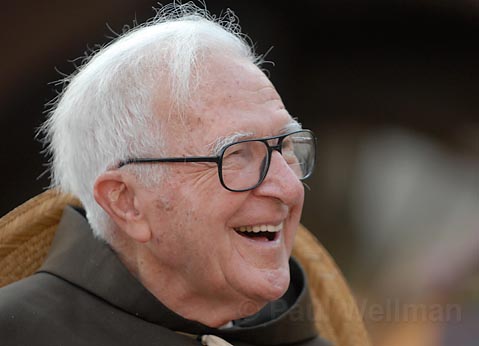
He was already a legend in town before I met him. By the time he died in 2008, he had made a lasting impression on me and many others. I’ve been thinking of him lately and want to tell you about him.
Born in 1919 to Italian immigrant parents in Sacramento, he came to Santa Barbara to study for the priesthood at the Franciscan seminary in 1934. He brought with him his sense of call, a love of baseball, and a brilliant and inquisitive mind. He became a priest at Mission Santa Barbara, serving our community for 74 years until his death in 2008. (That’s not a misprint.)
He was known as someone who welcomed, listened to, and celebrated people from all walks of life. He was a progressive voice for change in his church, in our community and the world.
In 1970, the Immaculate Heart of Mary sisters who ran the La Casa de Maria Retreat Center were changing many of their practices to adapt to the contemporary world. The Cardinal in Los Angeles told them they were going too far. They voted to leave the Catholic church and become an independent spiritual community. The Cardinal responded by prohibiting Catholic groups from going to La Casa and declared the sisters were no longer eligible to receive communion. Father Virgil believed in what the sisters were doing. He quietly ignored the Cardinal’s directives and led weekly mass at La Casa to support them.
In 1983, Queen Elizabeth made an official visit to Santa Barbara. The city chose Father Virgil to be her personal guide.
Virgil developed a special bond with many people, inlcuding biker groups. He established an annual tradition where groups from all over California would ride to Santa Barbara and arrange their motorcycles around the foot of the Mission steps. Virgil would lead a special service to bless them.
He was a Wednesday night regular at Harry’s Bar and Grill, a popular gathering place known for its history, welcoming atmosphere, and stiff drinks. He was once heard saying, “God lives at Harry’s.” The owners received his permission to put a sign outside the door, “Father Virgil says God lives at Harry’s.” There is a photograph of Father Virgil on the wall of Harry’s alongside the many Hollywood celebrities and politicians who have visited over the years.
My personal friendship with him began in the mid-1990s when I was asked to join two boards on which he was serving: La Casa de Maria and Hospice of Santa Barbara. When I arrived for meetings, I would do my best to claim a seat next to him so we could talk.
One year I asked, “So what are you doing for Lent, Father Virgil?” He smiled and said, “I’m giving up being around people I don’t like.”
Another year I asked him the same question. His response: “I’m giving up buying cheap wine.”
In 2002, my congregation was celebrating our new sanctuary by having a guest speaker every month. I invited Father Virgil to preach at one of our services and join me serving communion. We worked out an approach consistent with the Catholic practices he was obliged to follow. He arrived wearing his brown Franciscan robe and sandals. We entered the sanctuary together and led the service together. After the service, I stood with him greeting people at the door. But then I noticed one of my parishioners standing alone at the edge of the patio looking very quiet. I walked over to Louise and asked if she was ok. She quietly told me a story. As a child growing up in Ohio, she had a brother who had polio and spent the last two years of his life in an iron lung in a Catholic hospital. Two nuns took a special interest in him and stayed close to him day after day for those two years. When he died, the memorial service was held at Louise’s family church. At that time, nuns were prohibited from entering a Protestant sanctuary. It was winter and snow was falling outside. At one point in the service Louise looked up and saw the two nuns outside standing in the falling snow looking through a window. The sight broke her heart. She said, “That’s a wound I’ve carried with me all these years. Today, seeing Father Virgil preaching at my church, I think my wound has begun to heal.”
I would often ask Virgil what he’d been reading or thinking about. One time he said, “I just read a passage which said that when we finally come into the full presence of God, what will amaze us most will be God’s humility.” He smiled and looking away said, “I love that and can’t stop thinking about it.”
At the end of his life, Virgil was under hospice care at a local nursing home. The day before he died, he had become unresponsive, sleeping most of the time as often happens. A small group of people kept vigil at his bedside. Later I was told that one moment he suddenly sat up in bed and asked in a strong voice, “What’s the score in the Dodger game??” Then he laid back down and closed his eyes.
It was one of my life’s great honors to be asked to read a passage at his private memorial in the Mission chapel that occured prior to the public ceremony. The selection was 1 Corinthians 13: “If I speak in the tongues of mortals and of angels, but do not have love, I am a noisy gong or a clanging cymbal…”
In centuries past, “saints” were people who lived lives of purity and often died a martyr’s death. For me, saints are people who show us how to live life with both joy and service. They don’t ask us to separate ourselves from society. Instead they show us how to embrace the life we have before us and live it with open hearts, inquisitive minds, and a readiness to serve others. For me, Father Virgil will always be a saint.
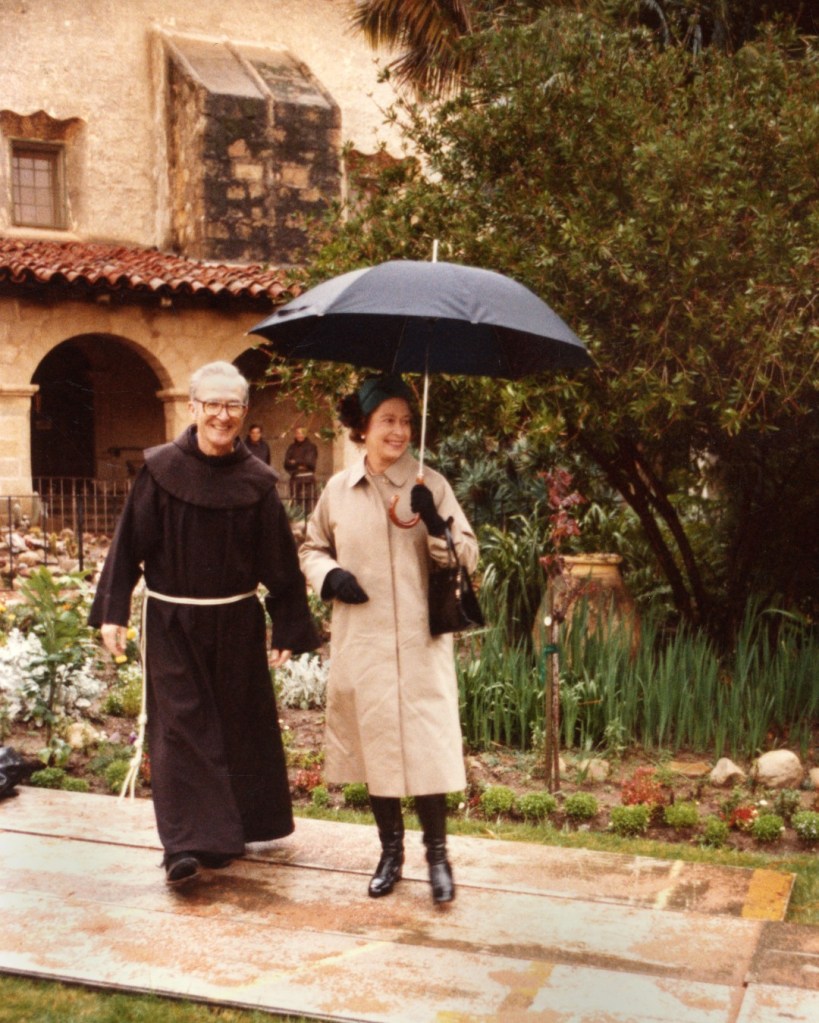
Father Virgil giving Queen Elizabeth at tour of the Mission

 Steve Jacobsen, Ed.D
Hi Steve There is so much I love about this. The stories about what he was giving up for Lent. The woman with the story about the two nuns. God’s humility. And especially the photo with the Queen! I agree that Fr. Virgil was a saint, and am very grateful to you for telling his story… Steve
Rabbi Stephen Cohen visit my website http://www.rabbistevecohen.com to see a selection of sermons, videos, poetry, wildflowers and more
LikeLike
Thank you, my good friend. I very much appreciated your FB post on the powerful conversation between the 3 people. I hope to come to your class today.
Please let Marian know my sister and I have booked an Airbnb in Balham…grateful for her advice.
SJ
LikeLike
What a lovely blog post honoring this saint. Thank you.
And it’s the start of baseball season. Go Giants (sorry).
LikeLike
Thank you, long time friend. I am so grateful we are still on the journey together.
LikeLike