Recently I’ve been trying to keep up with the unfolding nightmare in the Middle East, the ongoing threats to our democracy, and the growing effects of climate change. I ask myself what I can do about these and other issues while I do my best to manage my own responsibilities. As many of you know, it can be exhausting.
This week my thoughts turned back to a book that was a bestseller for many years: The Seven Habits of Highly Successful People by Steven Covey.[i] I’m often skeptical about self-help books that seem to oversimplify the complexities of life. However, I found Seven Habits to be useful.
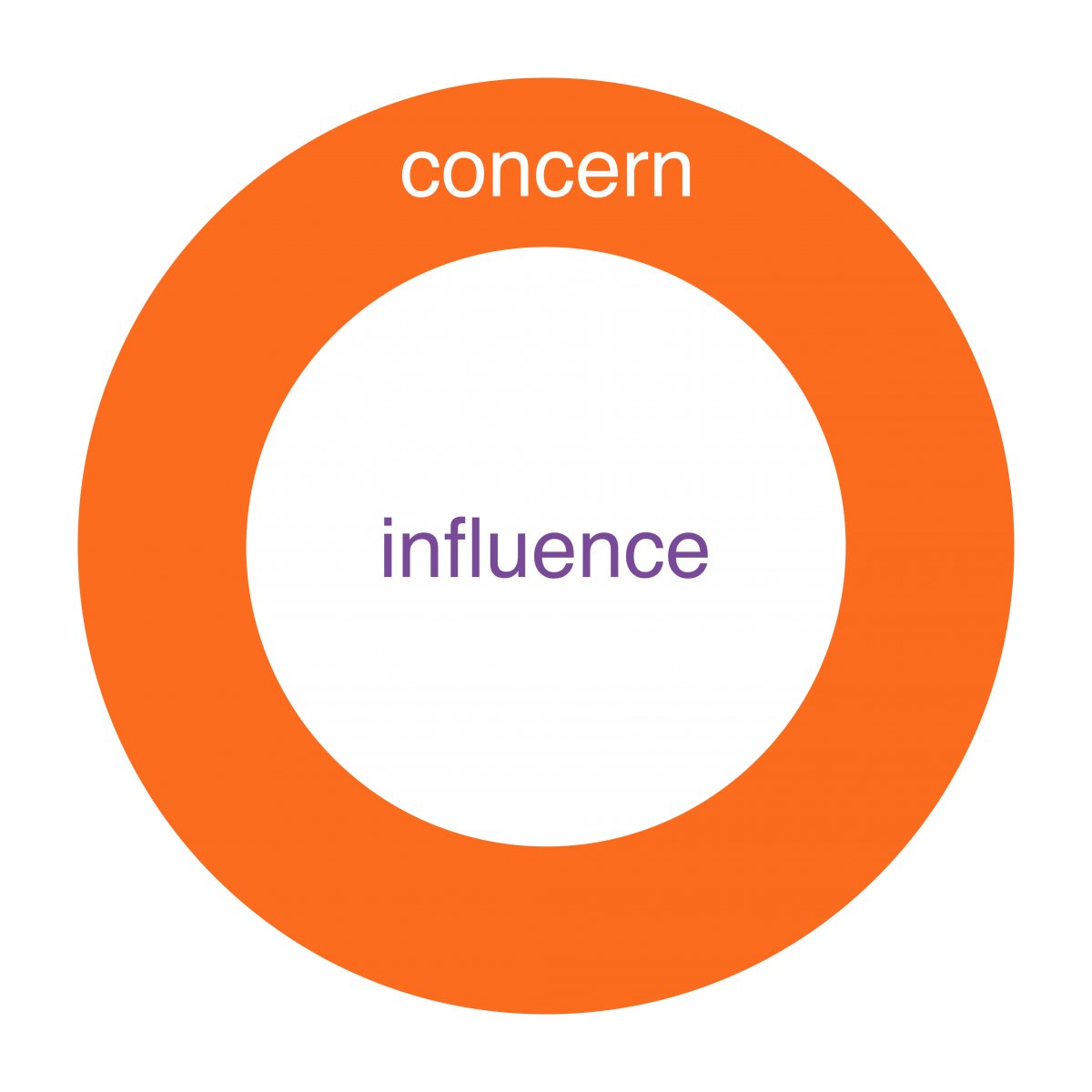
The first habit he called, “Be Proactive,” and a simple diagram can illustrate it:

Covey said we may be investing our attention in many things during the day and it can leave us feeling overwhelmed. But what if we separate what concerns us from what we can influence? To fret about things that concern us when we can’t do anything about them can drain and dissipate our energy. But if we focus on things we can actually do something about, we will discover we are not helpless. Instead, we will gain an improved focus that allows us to be clear, strong, and effective.
Many people have expanded on this concept, distinguishing what we can control from what we can’t. Here’s one example[ii]:

When you think about the situations and challenges that have occupied your attention today, which circle would you place them in?
This perspective is like the famous “Serenity” prayer:
God, grant me the serenity to accept the things I cannot change,
the courage to change the things I can,
and the wisdom to know the difference.
Deciding to let go of some concerns we can do nothing about and instead focus on those we can influence and control can be empowering.
But I will confess that sometimes a curious feeling arises in me when I try to see my life through this kind of lens: guilt. “I should always be concerned about events beyond myself;” I say to myself. “If I don’t, I’m just being selfish.”
But that’s not how it works.
As 2018 began, I was Director of the La Casa de Maria Retreat and Conference Center. Our staff of 45 managed 26 acres and hosted 12,000 guests a year. On January 9, a mud and debris flow wiped out eight of our buildings and filled almost half of the property with boulders, crushed oak trees, and silt. In the time that followed, we had to lay off 2/3 of our staff, some of whom had worked there for more than 30 years. Day and night I was trying to comprehend what had happened, how this was personally impacting the laid-off employees, how and when we might reopen, and what it would take to rebuild.
At one point I attended a social event at a friend’s house. I greeted one of our friend’s relatives who had been a wise and caring psychiatrist during her career; in prior years I had enjoyed meaningful conversations with her. She asked how I was. I said I was OK but was constantly thinking about the disaster. She looked me in the eye and said, “Make denial your friend.” I was shocked. Isn’t “denial” something we should never do? But as we talked, I could see what she meant. Thinking about heavy, complex things all the time can paralyze us. We need to take time to block out those concerns and engage in activities that replenish us. Then we can return to our responsibilities with fresh vision and energy.
It’s important to discover what renews us when we are trying to sort it all out.
I recently watched Ken Burns’ documentary “The Roosevelts” for the third time. It follows the tragedies and challenges Theodore, Eleanor, and Franklin each faced. They not only endured a great deal but became more skilled in leading and serving others. I was intrigued to discover that in the darkest days of World War 2, when the fate of the “Free World” was hanging in the balance, FDR would regularly take time to go sailing or bird watching. Then he’d come home and insist on mixing the martinis for his guests at 5 PM and enjoy their company. These times of “denial” were times of replenishment. Such practices help us to find the focus we need to make a difference.
I take my responsibilities in the world seriously and am actively engaged in organizations and activities that address the larger issues. But I find I need to manage my emotional and mental energy so I don’t become despondent or overwhelmed. Taking time to separate my concerns from things I can influence — then finding “the courage to change the things I can” – is a liberating and encouraging practice.
[i] The 7 Habits of Highly Effective People, by Steven Covey, 1989.
[ii] Lemonkind.co.uk

 Steve Jacobsen, Ed.D
Something I’ve been struggling with. Thanks for this very timely reflection…
LikeLike
Such a wise reminder, Steve. I’ll be sharing this with loved ones who are not remembering to take a walk, watch kids play or whatever brings moments of the joy that, despite the craziness of the world, are always available to us. Thank you as always!
LikeLiked by 1 person
Hi Steve This was especially timely and relevant…of course. I’m attaching my sermon from last Friday night.
For better or worse, I have stopped posting to Facebook; it was sucking up too much time and energy…
But I do feel a responsibility to offer my perspective. As things develop, I will be looking for other ways to communicate.
Especially now, I so appreciate your wise and compassionate voice.
Steve
Stephen E. Cohen
Senior Rabbi
http://www.rabbistevecohen.comhttp://www.rabbistevecohen.com
Congregation Bnai Brithhttps://cbbsb.org/
805.964.7869
Click herehttps://cbbsb.org/contact-us/ for services and event locations. You can also visit the CBB calendarhttps://cbbsb.org/news-events/ for specific event details.
LikeLike